The List for Herr Azmus

Destination Unknown

“What troubles you?” Asked Frau Schwimmer in a voice quivering on irritation. All of the other passengers were nesting comfortably in their seats, trying to catch a few hours of sleep before landing on the other side of the world. But not the young woman assigned to the aisle seat next to her.

“Nothing, um Nichts.” Thirty thousand feet below lay snow and ice infinitum. Ahead, the veil of darkness called night. Soon the plane would cut through that veil like a silver arrow rounding the curve of the earth, that is, if it didn’t crash in the frozen wastelands of Northern Canada. If that happened, Flight 32 would be lost forever. No search and rescue team would ever be able find the wreckage in all that whiteness. The passengers would have to eat each other to stay alive, like the Donner party. That is, if the plane landed intact, which it wouldn’t. It would tumble across the tundra, leaving bodies mangled in the metal as food for hungry polar bears.

The fidgeting continued. Frau Schwimmer noted the crumpled map on the young woman’s lap. “Where are you going?

“I don’t know. The town is called Gunthersblum but I can’t find it on the map.”

“We will find!” Frau Schwimmer pulled an industrial sized map of Germany out of her woven travel bag and patted the young woman on the hand. “Have not angst.”

Easy for her to say. She knows exactly where she’s going!

The plane shook violently. The seat belt lights flashed. “Air turbulence,” the pilot announced in English, then German, then French.

He’s lying. The plane’s lost an engine, sucked in a goose, or ruptured a gas line. It was going down.

Frau Schwimmer unfolded her map and calmly spread it over their two tray tables. “Ist these Gunthersblum Nord or Sud?”

“I don’t know.”

What an idiot? Frau Schwimmer’s thinking. Who flies to the other side of the world without knowing where they’re going? Certainly not her thirty year old daughter, the one already established and on her own in San Francisco.

“First we check index.” Frau Schwimmer ran her finger down the list of towns and villages: “Gunthersblum. Nein, Gunthersberg? Nein. Guntherslauten? Nein.” She turned to the hapless young woman. “You have perhaps written down the wrong name. There is no Gunthersblum.”


Dear Blogging Buddies – I’m re-editing a story that was published under the title The Graduate Present back in 2016. This story has taken me so long to write that it bears little resemblance to the maiden voyage on which it was based. Except for Herr Azmus. I have my high school yearbook to prove that he, at least, was real.

Shame on you Herr Azmus! You should have warned your German class about bidets and putzfraus!
  1. Destination Unknown

Come Sing a Song of Joy!

Santa gave me sniffles and coughs for Christmas (or it could have been a gift from the world’s most adorable snotty-nosed nine month old).  At any rate, my energy level is at an all time low. So I’m going to be lazy and repost a New Year’s Eve post from a few years back.

December 2014: Once you get to a certain age let’s face it. New Year’s Eve is about as exciting as taking out the trash. In fact I can’t remember the last time I actually stayed up until midnight. But there was a time when I drank champagne and toasted in the New Year in something other than sweats… really!

My most memorable New Year’s Eve was the inspiration for this scene from the now out-of-print book: The Graduation Present.  The main character, Riley O’Tannen, has to catch a New Year’s Day flight home out of Frankfurt Germany. However, she spends the night before partying and arrives at her uncle’s house with barely time to spare before they have to head for the airport. Here’s the excerpt:


I felt like telling Uncle Bob  that it was his fault for leaving me slightly tipsy at the club surrounded by young officers and their dates. His fault that light snow fell as we floated along the Rhine in a tide of other young adults, Beethoven’s “Ode of Joy” blaring from every restaurant barge, café and tavern:

Freude, schöner Götterfunken
Tochter aus Elysium,
Wir betreten feuertrunken.

Giddily we’d made up our own lyrics:

Weiner Schnitzel,
Bitte Danke,
Guten Tagen, Wiedersehen! 
snowglobeWe were in a snow-globe world. Sam from Colorado, Elke on the prowl, warm hearted Gil and a few others whose names I never caught, tap dancing on cobblestone streets, singing silly verses and laughing till our breath froze.

We arrived at the station just as the last train to Heidelberg was pulling out. “Run!” Sam yelled as we joined a crowd of young Germans rushing the train. Once on board, the chaotic scene made it impossible for our group to stay together. Unconcerned with the others, Gil grabbed my hand and pulled me through the mob.

Two cars down we finally found a seat and snuggled together by the window as the train rambled along. For once in my life I didn’t feel the need to talk. I was content to listen to the riotous laughter and singing coming from the other cars, while Gil fiddled with my long, stringy hair “looking for split ends,” he claimed with a chuckle.

CastleHeidelberg Castle sits on a hill overlooking a generally quiet campus town. Its fortress walls, which easily span several city blocks, were lit by a barrage of pastel lights. The crowd erupted in cheers as we entered the station and leapt from the train. The idea was to get as close as possible to the castle for the best view and so the mob snaked its way up the hill, along the route buying beer in red plastic cups and kazoos that sounded like drunken mallards from gypsy street vendors.  I realized in that particular moment we were not German or French or Italian or American; those labels were meaningless as we marched uphill to storm the storybook castle singing a song whose lyrics were universal. fireworksWe’d just managed to reach the medieval center of town when the fireworks began, first as fizzles in the falling snow, and then, mini starbursts.  These were promptly followed by sonic booms echoing in the clouds high above. The show continued for thirty minutes, gaining in intensity until the sky was filled with iridescent glitter raining down upon us. The finale, a blinding explosion of silver and gold, exposed armor-clad knights and their bejeweled ladies standing on the battlements in defiance of time and death.


Happy New Year’s everyone!

Happy Hour and Frisky Little Titties

Map

Occupation of Germany post WWII

In the early seventies Germany was very much an occupied country. According to Wikipedia, at one time there were over 196 military “installations,” which could be anything from an army barracks to a training area, storage facility or depot. Gradually they’ve been closed or consolidated; today there are only 42 and that number will be dropping in the next couple of years unless the cold war heats up. Let’s hope, dear God, it does not.

The only Americans who really understand what it’s like to live an occupied county are Native Americans. The rest of us cannot imagine having foreign troops on our soil, driving their tanks down our roads, building their bases on land that could be used for housing, disrupting our festivals, and, in many cases, sadly, raping our women. I’m not saying it wasn’t necessary to have so many troops stationed there. I’m just saying it affected the psyche of both the occupiers and the occupied. From the German perspective: Americans bought their food cheaply on army bases, received gas coupons to alleviate the exorbitant price of petro, and, with the money they were saving, hired local women to scrub their toilets.

Happy Hour

The college students I met reacted by becoming well versed on American atrocities and thus were more than happy to jump at the chance to point out just what an evil group of materialistic, war-mongers we Americans were. I’d been raised politely and thus didn’t point out Germany’s recent past, besides I knew they were lashing out however they could. And the Americans? Well, they tried to maintain little oceans of Americana on the bases – softball games, Indian Princesses, Cub Scouts and of course that very necessary of American traditions: Happy Hour.

It was the night of a thousand peanuts; casings and skins littered the bar and floor. When one bowl emptied, another was brought forth from beneath the bar to replace it as gin and tonics replaced Heinekens, shirts were loosened, ties were flung to the side, and jokes became raunchier and raunchier. Happy hour at the officers’ club was in full swing.

This week I’m throwing in an extra excerpt from the Graduation Present.  Our young protagonist (Riley) has just been picked up from the airport by her uncle and they’re driving through the German countryside to his home.  The captivating Gil and Oncle Boob are in the front seat chatting as Riley enjoys the scenery from the back.

This green landscape seemed so clean, so pure. The land of happy villagers, peaceful, loving peasants and urbane, chic, and sophisticated Europeans. I’d arrived.
“Gilberto, did you get a look at the knockers on Lou’s new secretary?” Uncle Bob blurted out, destroying my revelry.
“Molly, you mean Molly, right?”
“Yeah, I guess that’s her name. You know, the big ones are fun to cuddle but there is something to be said for frisky little titties. The French have a saying that the perfect size tit fits into a champagne glass. What do you think of that Gilberto? You like the little bitty titties?”
“Ah, Uncle Bob. I’m in the backseat,” I reminded him.
“So? You got a thing against tits?”
“I can’t believe I actually thought you were a spy.”
UncleBobSpies don’t like tits?”

Through Other Eyes

The first time I went to Europe, so full of romantic illusions and so desperately naive that it’s painful to think back upon that time, many things took me by surprise. First, it wasn’t Disneyland.

“Jan at fifteen” by Connemoira

Second, the war which seemed so long ago to me, still hung over the continent as if it had happened the day before I arrived.  I will never forget seeing WWII, not from across an ocean, but through the eyes of people who’d lived through it and for whom it remained a constant shadow.

However, what gave me the most pause were the lowered expectations of the young people I met. In America, everyone wants to be a movie star or athlete. In America, it’s drummed into our heads that not only could everyone go to college but everyone should want to go to college, as well as buy a house, a car, twelve television sets and membership at the local golf course. To do otherwise was – for my generation – lazy, degenerate behavior, ultimately resulting in a life spent on the street with a bottle of gin hidden in a paper bag.

Thus, running into young villagers perfectly happy to remain at home, with a life no better than their parents, caused me to rethink American values.

I lived in a village unchanged for hundreds of years and populated by people of Slavic descent who’d migrated there for political reasons. As in many small villages in Europe, during the day there were practically no young people on the streets, only old women tending small children. The parents of the children and young people old enough to work, commuted to one of the larger cities nearby.villagepeg

I met Inga and Hans only because they were both on vacation; he was on leave from the army and she was taking a short breather before training to become a shop clerk. They lived with their folks and had no immediate plans to move out. Nor was college or a car a remote possibility.

From the Graduation Present: It depressed me to see young people my age without the hunger to change the world or to rise up the ladder to what we in American defined as success; more money, more power; greater knowledge than our parents. But, on the other hand, they were happy, content, and secure, on a path that wouldn’t lead to an uncomfortable place. I envied them in a way. If I told my parents: “I just want to live with you the rest of my life, work in the local store, maybe travel a bit,” they’d blow a gasket.

I regret to say that after I returned stateside, I got a letter from Inga and Hans asking if they could stay with me when they came to the United States. My life was then in such flux that I never responded.

Oncle Boob’s Fest Hopping Strategy

Setting: The young woman and her uncle are waiting for a friend of his to arrival so they can all go fest hopping (visit all the local harvest festivals) .

She found the kitchen full of Germans, all clamoring around her uncle. Some of them she recognized—Heinrich from the train station/post office and the elderly couple who lived across the street. But most of them the young woman had never seen before.

After exchanging happy banter with her uncle and slapping him on the back, they each grabbed either a carton of cigarettes, a tin of coffee, a jar of peanut butter or some other American delicacy before leaving.

“How did you get all this stuff?” She asked, after making her way over to him.

“I saved up unused ration cards from people who’ve been transferred stateside. This stuff is too expensive for my buddies here,” he said, turning to the older woman who lived across the street. “Omie, here, just loves Rocky Road ice cream. Don’t you, Omie.”

Omie grabbed the container he’d pulled from the freezer. “Danke, Oncle Boob!” She smiled and then quickly made her way out the front door as if someone else might be interested in the coveted prize.

“Thanks to you I seem to have a new moniker: Oncle Boob! Makes me sound a bit like the village idiot, doesn’t it?”

The young woman mumbled an apology but couldn’t help but giggle herself. Oncle Boob!

The giveaway lasted about an hour with everyone getting something and everyone leaving happy. The young woman thought it an auspicious start to the day but Oncle Boob did not share her optimism: “Newsome’s going to ruin everything! He was supposed to be here an hour ago.”

He had meticulously drawn out their route on a map of all the local fests that he’d gone to great pains to acquire. Then he’d rated each and every one in case they weren’t able to attain his ultimate goal of visiting them all. The prize being bragging rights at the officers club. A great honor indeed and one which had been his, on many occasions. On his map, the Must Visit fests were circled in red while the Nice to Visits were circled in blue. Each fest was also given a priority level of one through five.

“I’d better reassess my plans,” he complained after another half hour passed. He pulled out the map and began studying his fest-hopping strategy with all the seriousness of a four star general planning a sneak attack against a much better equipped enemy. “The Leusdorf fest will have to be downgraded to a four. It’s too far east. We couldn’t possibly swing back to Klingerbrick and still make Rheinfell. Goddamnit Newsome! It’s almost eleven!”

Just when it looked like her uncle’s assault on Rheinfell was in jeopardy, Charlie Newsome appeared, perched precariously on an antique motor scooter that he could barely handle. “Look what I’m reduced to, Bob. A goddamned motor scooter. I can’t even remember which of the exes left this pile of merde behind on her way out.”

But the Oncle Boob wasn’t in the mood for idle chitchat. The campaign was already an hour behind schedule. “Put that ugly thing around back and get in the damn car,” he said, pulling the front seat of the VW forward.

“In the back? It’s smaller than a shoe box.”

“That’s true but Niecey here has to drive. God help us. She can barely keep the car on the road but, Lou will shoot us both if we get caught driving again.”

“I think he’d consider a firing squad too light a punishment.”

Excerpt: In Honor of Those Boys

Cemetary-2

American Military Cemetery in Normandy

Ten years ago, just before the sixtieth anniversary of D-Day, my husband and I took a trip to Normandy. We stayed in the tiny fishing village of Grandcamp Maisy on the marshlands below Pointe du Hoc, a 100 foot promontory overlooking the English Channel. Because the cliff was the highest point between the beaches which came to be known as Omaha and Utah, the Germans massively fortified it.

Mural-1

The painting depicting the Siege of Pointe du Hoc

Every morning we would have our coffee beneath a large painting depicting the US Ranger Battalion’s insanely brave assault and capture of the pointe using ropes and other mountain climbing tools.
Anyone traveling in Europe can’t help but be reminded of the war.  Even a naive and often silly young woman, like Riley O’Tannen is profoundly affected by the stories she hears.

OmahaBeach

Omaha Beach, Normandy, France

From the Graduation Present (currently out of print)

“I thought of those young kids from small-town America, about to jump from a rattletrap plane into the unknown, for that one last moment believing Hollywood crap of fame and glory, then dropping with fewer chances than a duck in a shooting arcade into an alien land, a land they’d been assured would include cheering crowds and willing women, which they would never see because they would splat like frogs into marshes filled with dung or float to earth full of bullet holes. And they were the lucky ones.”

Excerpts – Putzfraus and Bidets

I always dreamt of seeing Europe (the castles, the quaint villages, the timeless cities) so as soon as I was old enough I jumped at the chance to study foreign languages.
My first French teacher, Madame Burkholder, had us spend all our time memorizing dialogues in which we pretended to be young French students going to the library. It must have worked because after three years, the only phrases I remember to this day are Ou est la biblioteque? and Le matin papa apporter mon frère, ma soeur et moi au musee du Louvre
Two phrases I have never ever used in all my travels.  Who asks to go to the library in a country where they can barely speak let alone read the native language?
In high school I decided to branch out to German.
HerrAsmusMy teacher, Herr Asmus (that really was his name), looked just like Ichabod Crane.  His class was held in the same room used for Sex Education.  Thus my most enduring memory of Hairy Asmus was of him turning to a diagram on the wall beside him and snorting in disgust “How can I be expected to teach German with this  giant penis staring me in the face????”  We spent most of our time pretending to be tour guides.  The only phrase I remember from that class is:  Im Jahr 1950 König Ludwig der Zweite hatte diese berühmte Schloss geschlossen.
 Since no one in Germany ever asked me when King Louis the Second closed his famous castle,  I never had a chance to use that phrase either.  In fact the first person in Germany I  tried to communicate with was a cleaning lady.  That experience inspired the following scene from the Graduation Present.  Riley O’Tannen has just spent her first morning in the tiny town of Gunthersblum trying to communicate with her uncle’s cleaning lady (Putzfrau).  Around noon she receives a call from her uncle and takes off for Worms where he works hoping to have her first real german meal, but instead she is picked up at the train station by the intriguing young man she met the night before, Gil, and driven to the Officers’ Club for a burger.

cropped-envelope21.jpg

From Chapter Two of the Graduation Present


“Your uncle’s only on his first martini,” Gil explained wryly. “So, he sent me to get you. He’s only got an hour for lunch which doesn’t leave a lot of time for …”

“Booze.” I muttered to which he laughed.

When I’m nervous or self-conscious I become a regular Chatty Cathy and so it was with poor Gil as we drove through the streets of Worms. First he had to hear all about the train station that was also the Post Office, the conductor who thought I’d changed identities between stations and kept demanding to see my passport, the Putzfrau and her cleaning fetishes and finally, regretfully, my confusion over the two toilets in Uncle Bob’s bathroom.

bidet

What do Americans use bidets for?  Soaking their tired footsies, of course.


“Well, that seals it,” he teased. “You are a country bumpkin! The second toilet is a bidet. It’s for washing up that part of your anatomy after you go.”


What’s the most useless phrase you ever learned in a language class?
Next time:  cooking lesson with Oncle Boob.  Eggs with Hats, the sure cure for any hangover.

Excerpts – Lapin au Jus

Setting:  a Parisian restaurant where our heroine (the young woman) is having dinner with her chaperone (the wealthy, mysterious  and very gay Lou Raferman) and his old and dear friend (an Englishwoman who is one of the founders of the Deadly Dames Book Club)

****************

“How do you say ‘you’re all very fine waiters’?” The young woman asked Lou.

He turned from his conversation with Mrs. Chrisholder. “How many glasses of wine have you had, my dear?”

“Oh, I dunno. They just keep giving me more.”

“Well, perhaps you should pace yourself. The main course is next and it’s something you want to save your palate for. People make reservations months in advance just to taste Chef Michel’s lapin au jus!”

Lapin, she thought. What the heck was that? Before she had a chance to ask, the main course arrived. The lump of browned meat on her plate slightly resembled a very plump chicken thigh. It was covered with sauce and dressed with grilled celery. “Mr. Raferman, doesn’t ‘lapin’ mean ‘rabbit?’”

“No, it means ‘Hare,’” he replied rather stiffly.

The young woman poked the meat with her fork. It jiggled. Not only did they expect her to eat a bunny, but an underdone bunny. A bunny butchered by some horrible man in a dirty apron, then hung outside a shop to drip blood onto the sidewalk. Once it had had soft fur and a funny little nose. Once it had hopped merrily through fields doing harm to no one. Then it was slaughtered.

“I can’t eat this,” she said to the waiter. “I’m too full. J’ai trop mangé.”

“My dear, it’s the chef’s signature dish! You must eat it.” Lou commanded, “Mangé, mangé!”

“It’s a bunny, Mr. Raferman. A bunny!”

“It is a rabbit and you must eat it!”

“I can’t.” Tears ran down her face and onto the bunny.

The waiter grabbed her plate. “Végétarienne!” he snorted.

Lou’s mouth fell open. He glanced towards the kitchen as though at any moment the chef would emerge with a cleaver. Then he stood up, threw money on the table, and announced they were leaving.

Wacky Travel Tales

Cartoons_0003

For the last couple of months I’ve been blogging about the wild time I had on my first trip to Europe, which would have lived on only in a cardboard box had it not been for a writing contest back in the 1990s. The challenge was to write about “our wackiest travel adventure.”  I immediately riveted back to my ignorant youth when I traveled the world naively believing that the universe would take care of me.  Twenty years later that challenge evolved into THE GRADUATION PRESENT (on Amazon now). Of course it’s impossible to remember everything that happened 40 years ago so this book is primarily fiction. However, there are a few real life incidents that I just couldn’t help adding.

My Uncle Bob (who I stayed with in Europe) read the first drafts of the book and said:

“I don’t remember any of these things happening, Jan.”

Cartoons_0004

To which I  said “That’s because it’s a work of fiction!”

He looked at me oddly.  “But Gunthersblum is real and Worms is real and I’m real!”

“Okay, there’s a little real even in fantasies.”

Still dissatisfied  he went on to ferret out the real.  He couldn’t.  Forty years is a long time.  This particular scene which he vehemently denies ever happening actually did:

“Did you see all those young lieutenants at the bar?” Uncle Bob asked as we waited for our meal.

“Yeah,” I lied. I couldn’t tell a lieutenant from a general.

“Well, I figure that they’d all love to take a pretty American girl out to dinner.”

“What?”

“I was thinking, why should I be the one who has to feed you when there are all those young studs who’d gladly …”

“Uncle Bob!”

“You know, you’ve gotta learn to use what you have while you still have it. Think of it as the law of supply and demand. You’ve got the supply and they’ve got the demand,” he said, taking a chomp out of a breadstick.

Whereas the following scene is complete fiction, although the character of Lou was loosely based on Uncle Bob’s boss at the time:

Outside it was dark. The rain had stopped. “She sleeps!” The Moroccan shouted again. Lou appeared a few minutes later in the door. I could only see him in silhouette but I could tell he was livid. His aura was bright red.

“Where have you guys been?” I asked innocently.

“I was investigating your kidnapping!” he snorted.

“My what?”

“YOUR KIDNAPPING!” he yelled, stomping his foot like an enraged Rumpelstiltskin.

The following bit of musing was inspired by listening to my uncle’s friends who were WWII vets talk about their experiences:

 I thought of those young kids from small-town America, about to jump from a rattletrap plane into the unknown, for that one last moment believing Hollywood crap of fame and glory, then dropping with fewer chances than a duck in a shooting arcade into an alien land, a land they’d been assured would include cheering crowds and willing women, which they would never see because they would splat like frogs into marshes filled with dung or float to earth full of bullet holes.  And they were the lucky ones.

I wish some things in the book hadn’t really happened but they did, such as:

Unfortunately Uncle Bob was wrong. Not every moron on the planet can pass the army typing test and I’m living proof of that fact.

Army Life
Army Life

I made army history by flunking the idiot-proof army test three times.

So a bit of truth and a whole lot of imagination went into the writing of the book as I imagine is the case with most novels.

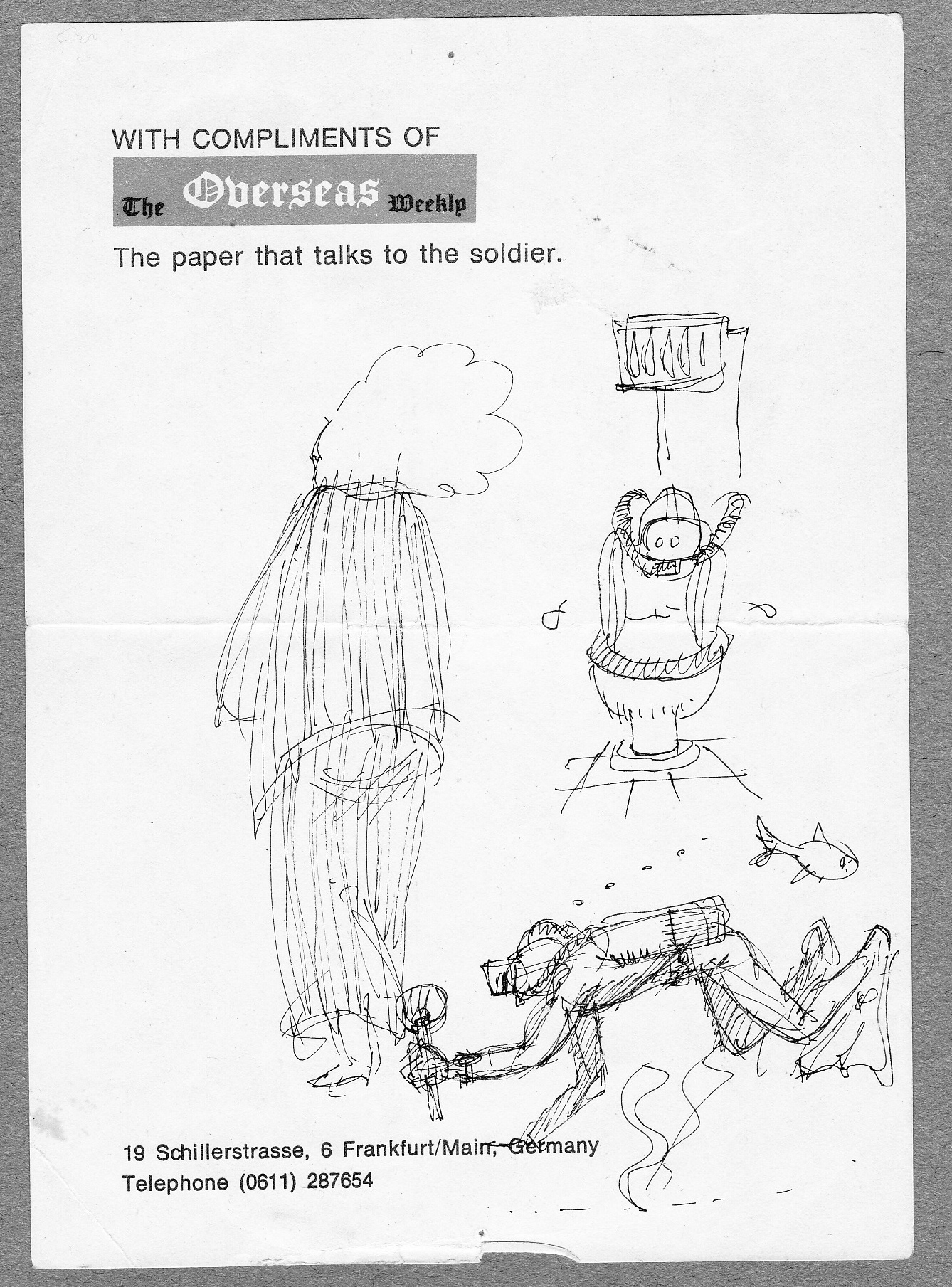
Next time I’ll post the first chapter of the book.  Oh, the drawings on this page are doodles drawn by the cartoonist for Stars and Stripes, the armed forces newspaper, as we sat drinking Heinekens in the bar of the Officer’s Club in Worms Germany.  Alas, I’ve forgotten his name. If anyone out there recognizes the work, please let me know.