Why we need Sheriff Taylor

The other day I watched an episode of The Andy Griffith Show while having tea. That show, for those of you who’ve never seen it, is unapologetically set in Trump country. That is, if Mayberry had been a real town and not a set on a backlot in Hollywood. 
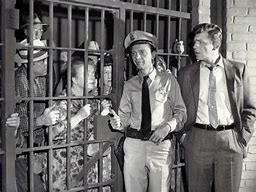
Deputy Sheriff Barney Fife locks up the whole town for minor infractions of the law when Sheriff Taylor is out of town.

The townsfolk of Mayberry are not sophisticated or worldly.  Few have been far from the county line.  But they have a strong sense of pride in their small town and are hurt when outsiders call them country bumpkins. Of course the town did have its stereotypes: Otis, the town drunk,  Goober and Gomer, the village simpletons, and Floyd the barber who can’t stand electric razors.  But they are treated gently and shown to be, despite their gullibility, decent folk at heart.  It’s their lack of worldliness that causes them to leap to judgement and act accordingly. When a stranger comes to town claiming to be something he most definitely is not, they take him at his word.  Similarly if a stranger comes to town and keeps to himself then he must be hiding a deep, dark past.  The lack of regular interaction with strangers causes them to be either too trusting or too suspicious. In either event, it’s Sheriff Taylor who has to expose the truth, but, in a way that doesn’t make anyone feel foolish or cruel.  He knows that simply telling someone they’ve been duped will make them defensive and then they won’t listen.  And then they will make up alternative facts to believe.  Does it sound familiar?  

I found it fascinating that after Don Knotts’ death the actor Billie Bob Thornton wrote:

“Don Knotts gave us the best character, the most clearly drawn, most perfect American, most perfect human ever.” 

He was referring to the character of Barney Fife, the bumbling deputy sheriff of Mayberry. Barney is a mass of contradictions – overly confident (one might say self-delusional) one moment and full of insecurities the next. If you’re unfamiliar with the show, below is the shortest clip I could find.  Barney is the one in uniform.  What do you think?  Perfect human?

Death and the little thing called life

The other day a friend  told me about a Netflix show, the Frankenstein Chronicles, that interested him.  So I decided to check it out.

If you haven’t been following the series, first of all, it’s set at a time when London was literally a sewer, they burnt coal with no restrictions, and poor families tossed children they couldn’t feed out into the streets to fend for themselves. In addition,  Sean Bean (aka the beheaded Ned Starke from the Game of Thrones) plays a detective tasked with finding the “monster” who’s been mutilating dead children and grotesquely stitching them back together again. It’s critical to find this person because when Jesus returns to earth those of us who’ve been good will get to sit next to him but only if we have a body to reoccupy.  Preferably one that has not been chopped up or in other ways violated.  Jesus is evidently a bit picky about who he keeps company with.

Now, I know what you’re thinking.  Jan, you’ve gone off the nut once again.  So let me explain.  In the 1800s, medicine was evolving into a science. Doctors were on the verge of many advances to help prevent premature deaths from childbirth to plagues.  But only, dot dot dot, if they could get a better understanding of human anatomy and to do that they needed, dot dot dot, corpses. The corpses were happily provided by prisons and poor houses as those blokes weren’t going to sit next to Jesus anyway. But innocent children were off-limits.

Ned Starke to the rescue

As to why the preoccupation with death, remember life wasn’t so great back then. This fact was seized upon by preachers promising a meet and greet with the big JC, thereby making death the reward for a virtuous life.  So, in the Frankenstein Chronicles, when mutilated children’s bodies begin littering the shores of the river Thames, fingers are pointed at the scientific community.  It must be doctors dumping their botched experiments, thereby depriving children of a wonderful after life experience. Our hero has a different theory but I doubt I’ll stick around to watch all three seasons (sheesh) just to find out if he’s right. To me these Netflix series’ start out with an interesting concept but then somewhat rapidly become expensive soap operas sans the cheesey acting.  However, the producers and screen writers have done a brilliant job of depicting the environment that spawned early horror classics such as Frankenstein and Dracula. 

As a writer I’m not sure we’re always aware of the environmental and societal forces shaping our work. I doubt either Mary Shelley or Bram Stoker thought “I’m surrounded by death so I might as well write about it.”  But maybe I should speak only for myself.  What do you think?