I guess it’s only human nature to hope that the things we’ve collected over the years have some value beyond the sentimental. Especially if we inherited said items and have dragged them from hither and yon like a yoke around our necks!
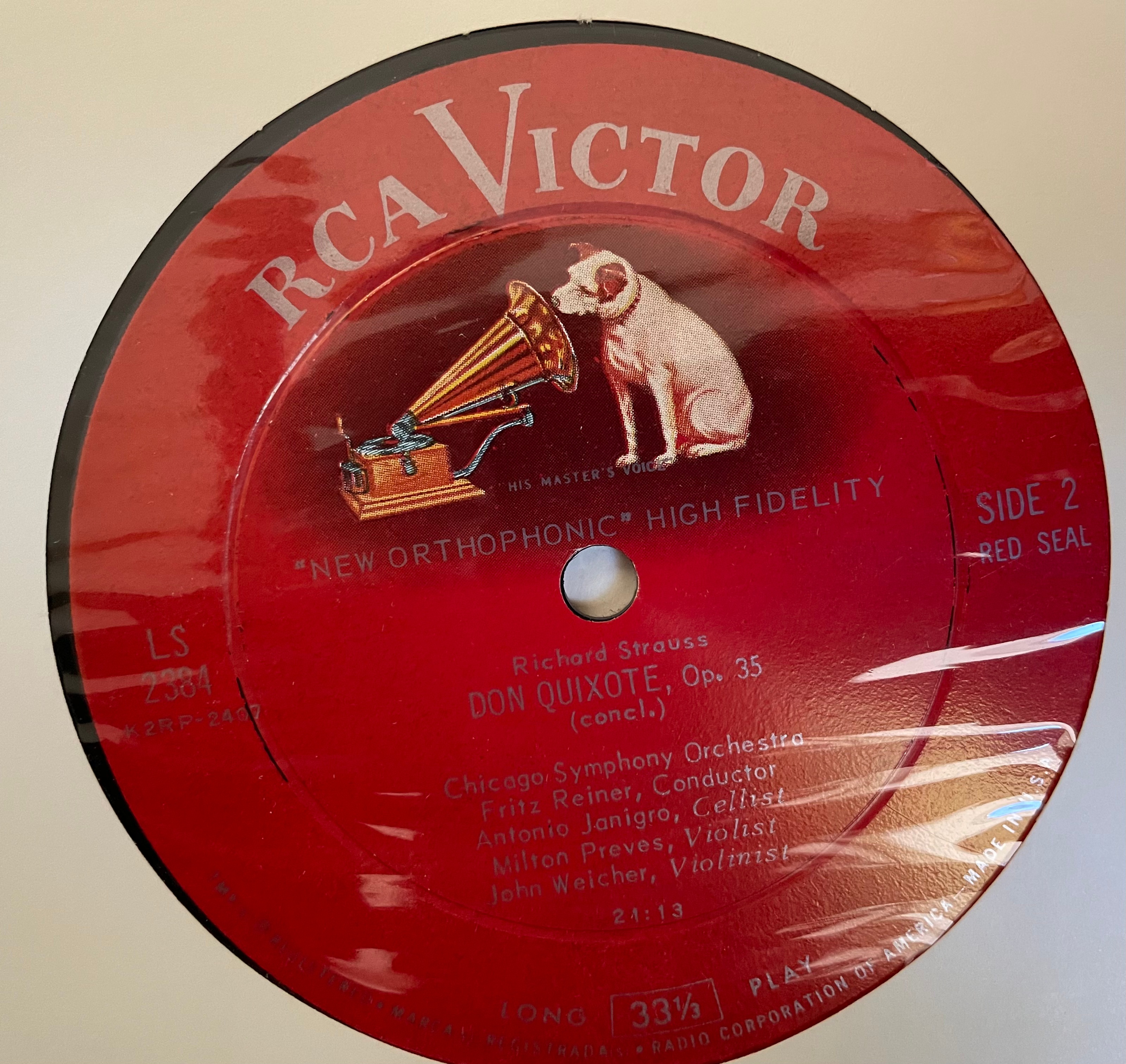
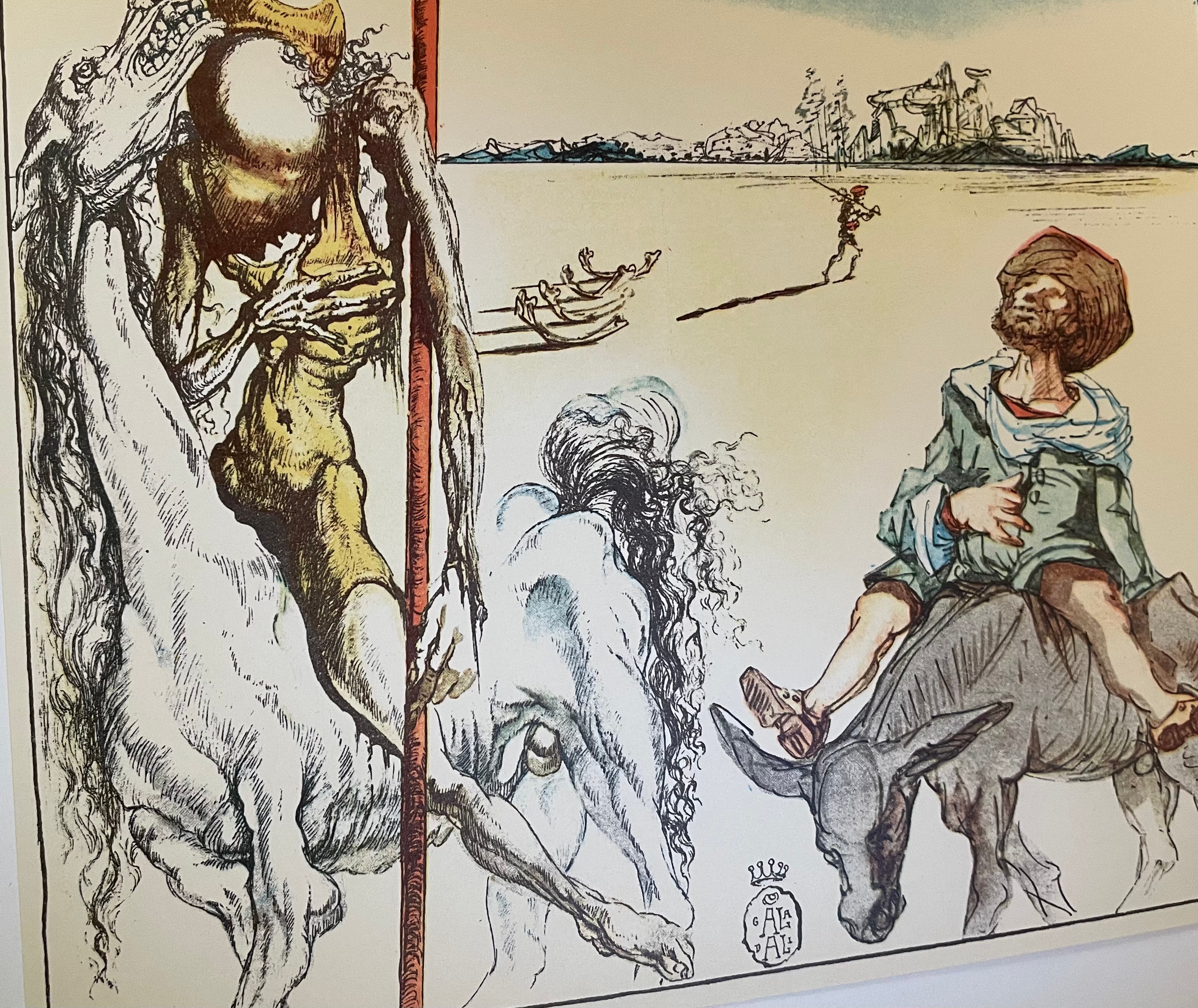
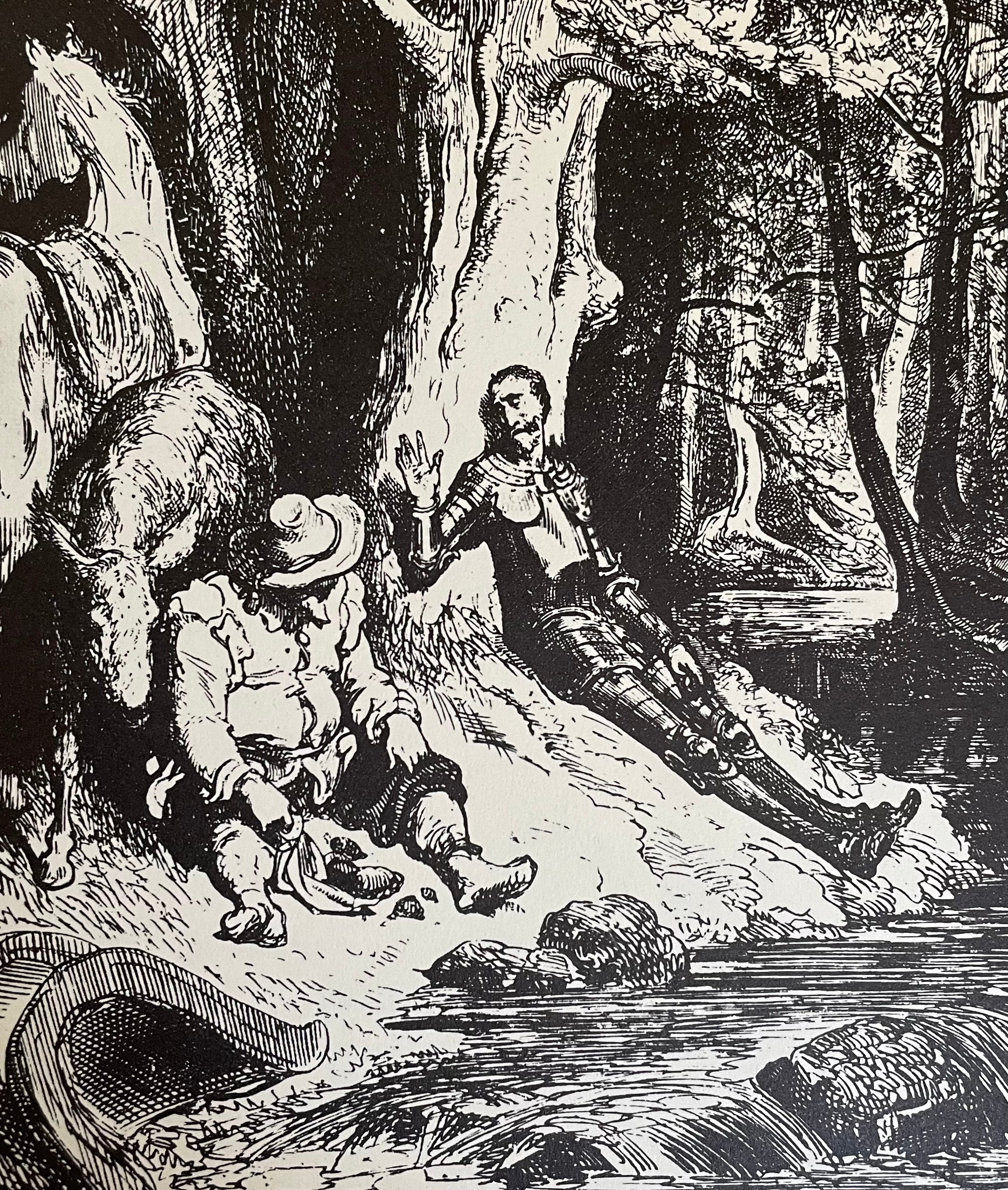
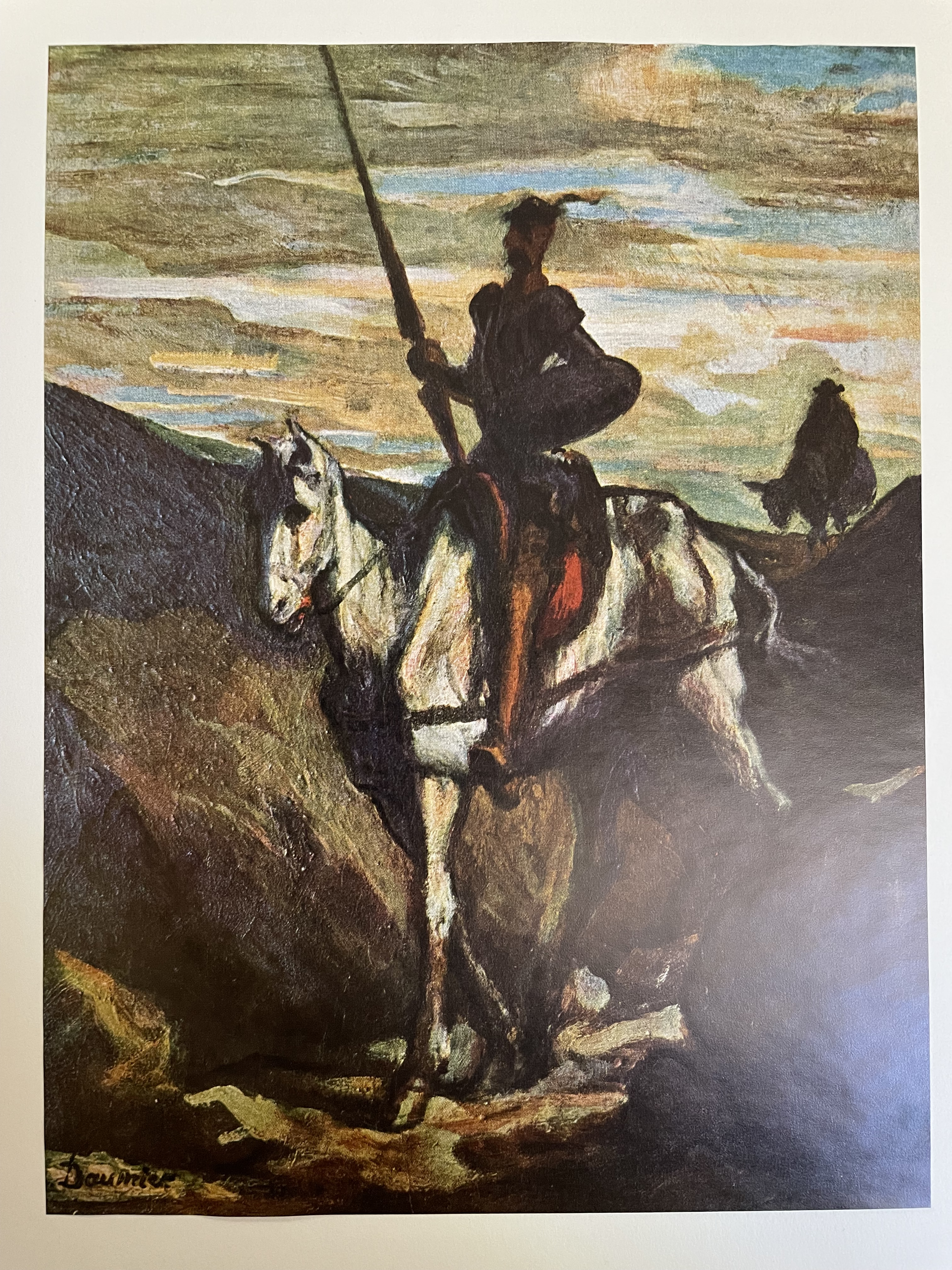
But guessing the value of old records is a crapshoot as far as I can tell. The above recording of The Tone Poem Don Quixote was sold with a linen cover as a part of the Soria Series of classical recordings produced by Dorle and Dorio Soria for RCA Victor probably in 1958. Each came with a booklet written by experts on the subject. For Don Quixote, the booklet was written by Walter Starkie, an “authority of Spanish history and culture, an eminent scholar and writer” and illustrated by the artists inspired by Cervantes’ (Dali, Picasso, Goya and Dore)
Picasso
From what I’ve been able to tell, this album plus booklet is only worth about $30 to collectors. So we shall hold onto it. I never made it through Cervantes’ masterpiece so perhaps it shall give me the motivation!
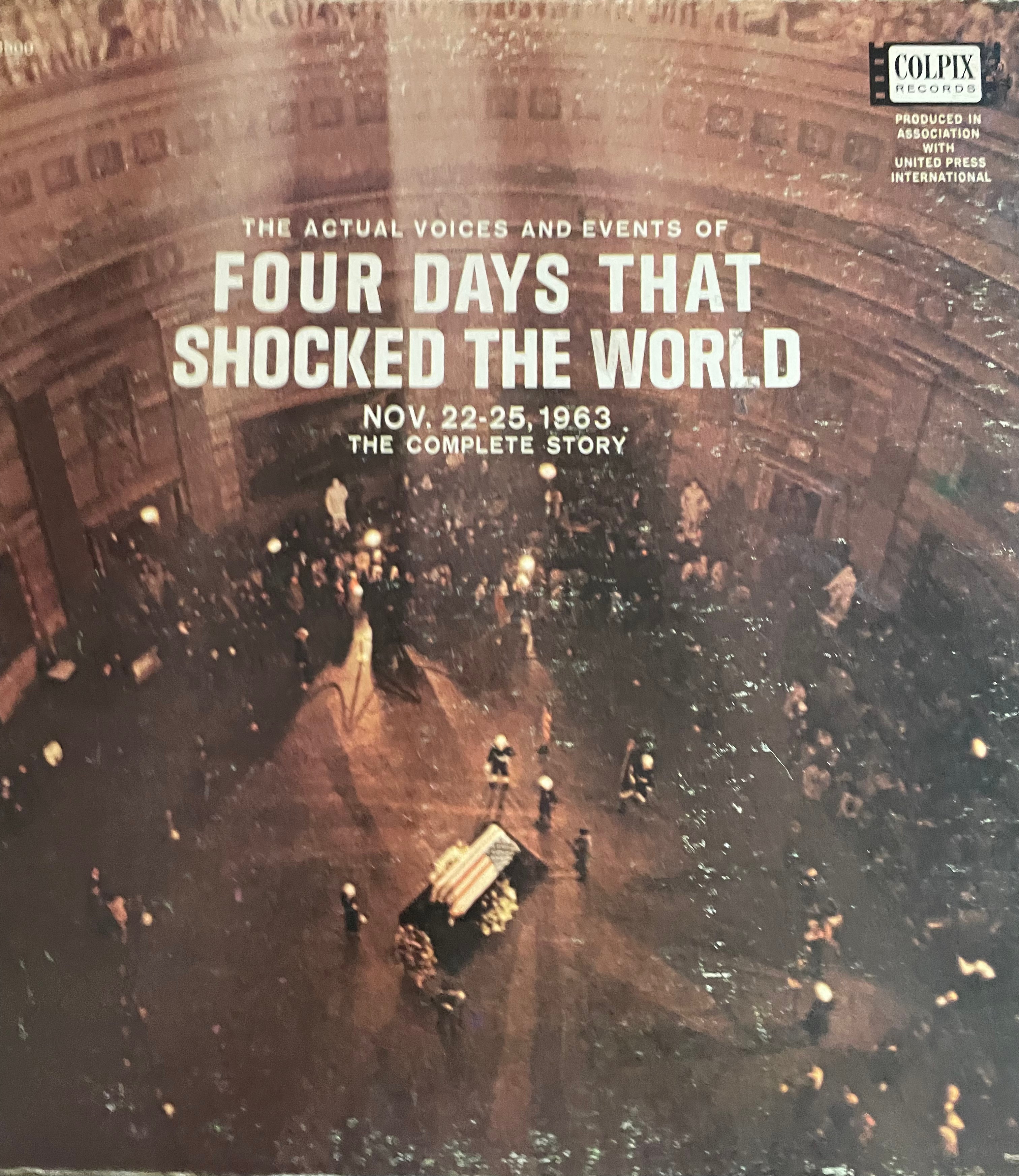
On the other hand, this album is highly sought after.
All I can say is Ugh. I guess there are a lot of conspiracy theorists out there!
I also counted about a dozen “Live on Stage” albums in our collection. I don’t really understand the allure of the live-on-stage recordings. Who wants to listen to the applause or the back and forth with the audience? Not me. However, the following recording might be interesting. I was in grammar school when it came out as was my husband so how it came into our possession is anyone’s guess.
Unless my prim and proper MIL had a Walk on the Wild Side? Noooo.
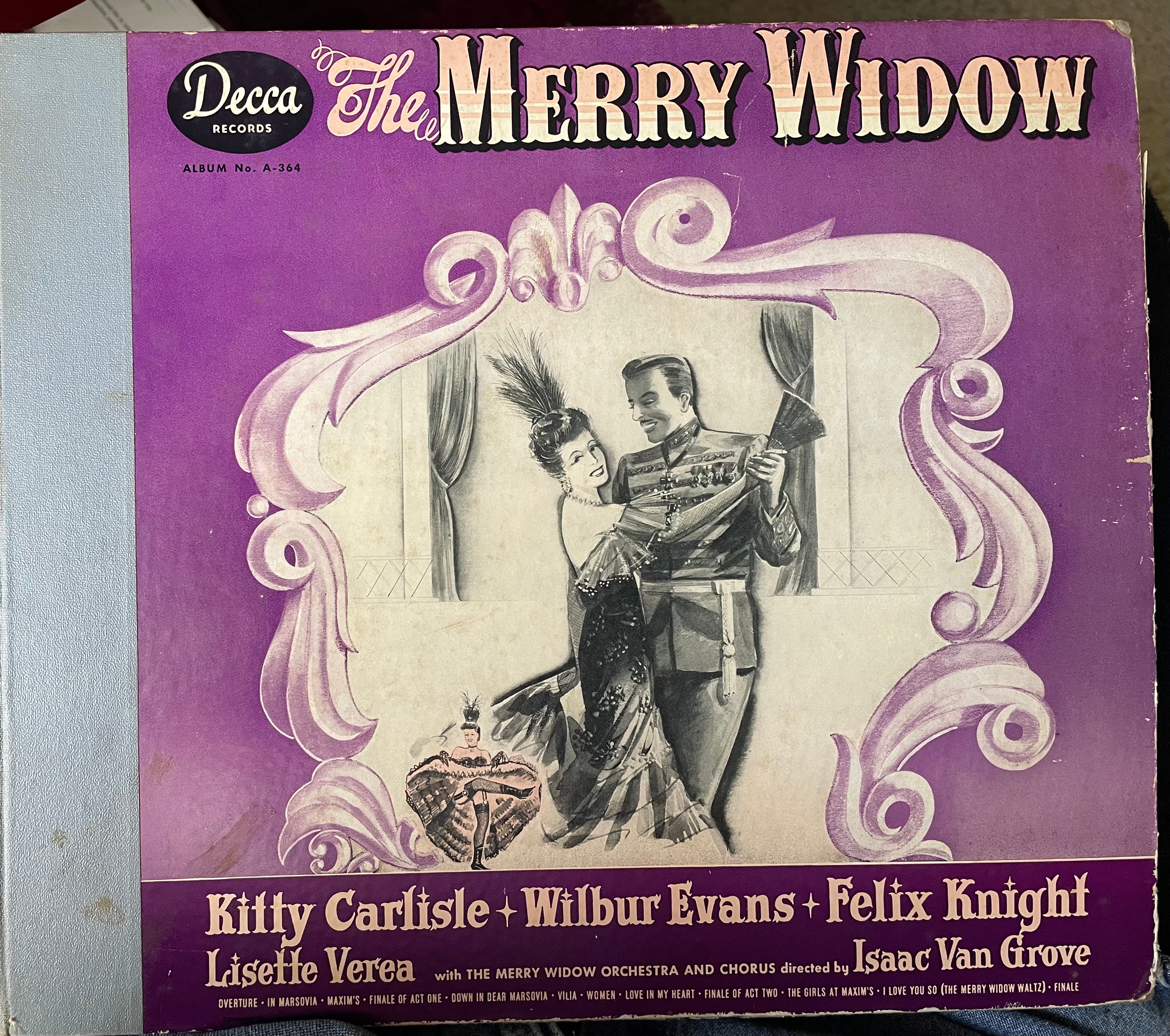
I’ve gotten tired of researching the value of old records and so I will conclude with the most valuable record set I found. From around 1946, the six record set of The Merry Widow. Estimated value $60-70.
I’m not sure I’ll be able to play this set on my record player. The discs are only 10″ and very heavy. But we’ll see. If not, I know a near-by thrift store that might welcome the donation!
In a previous life I worked for a midwesterner named Linda who’d been assigned to help a group of programmers find billable hours before they were kicked off the good ship TR Wonderful where they were being held captive. You see, their ship (The Milvia) had been sunk by the larger and much more powerful Wonderful the year before and now the crew of the Wonderful was doing all it could to make them comfortable. However, the customs of the Milvia and the customs of the Wonderful could not have been more different if they tried.
The Milvia on the high seas of Berkeley California – fueled by all nighters and triple Lattes!
Linda, bless her heart, had no idea what these programmers were capable of but she did have a copy of the TR Wonderful Jobs List updated weekly and faxed to various outposts around the planet from the HQ in Cleveland Ohio.
Its arrival (generally on a Tuesday morning) was always cause for joy. “Jan,” Linda would say to me, “I brought cookies. Tell the gang we’re having a do! The list is here … on time and on schedule.” Of course, one would expect no less from the HQ of TR Wonderful!
Once a giant in aerodynamics, electronics and credit card processing industries before being sunk by The Northrup Grumman
In case you’re wondering, in Linda Lingo a “do” was an informal get-together generally in the coffee room and lasting no more than 15 minutes. There would be an announcement, light refreshments and then everyone would return to work. Fifteen minutes a day of unbillable time was all you were allowed. Every other minute had to be charged to a project, duly noted on a paper timesheet and approved by a manager before being sent on to payroll. If the project you’d been assigned to ended, your name was added to the Availability List. Thereafter you had two weeks to find and be accepted on another project. Otherwise … you walked the plank.
Thus, you can understand why the arrival of the Jobs List was cause for a “do.”
Poor dear Linda really was a sweetheart. I can see her now … a petite blonde of maybe fifty, always clad in a conservative pastel pantsuit with matching shoes and accessories, trying to convince a life long resident of Berkeley California that he would just love Oshkosh Wisconsin. It was, after all, the birthplace of the “dungarees” he practically lived in.
Poor dear Linda. She really was a sweetheart. But it was inevitable what happened.
“Why do they insist on calling it a Layoff List?” She’d ask me almost in tears. “At TR Wonderful we don’t lay people off. We give them every opportunity to remain on board and enjoy all the benefits of a good health care and retirement package. They might have to move far from home but they would remain a part of the TR Wonderful family and what could be more wonderful than that!
I never knew how to respond. In retrospect, companies which encourage their employees to stay aboard with good health benefits and pensions are a dying breed. But, to those of us used to a pirate ship, their corporate ethos felt suffocating. And so I just shrugged my shoulders like a dummy.
“And why are they having all those bashes? Every Friday night — another bash!”
A bash was like a “do” … an impromptu get-together but bashes were held at some nearby “joint” that served alcohol (TR Wonderful did not allow alcohol to be served on site … unless in the boardrooms for executives, of course). We invited her to the bashes, of course, but she never came.
I often think of her on Fridays, sitting alone in her office as we all left to help our friends celebrate their escape from TR Wonderful and the horrors of pleading for billable hours. Poor dear Linda.
The last on my list of beloved Christmas stories is Dylan’s Thomas’ A Child’s Christmas in Wales, a piece that is best appreciated when read aloud. Below by the unforgettable Richard Burton who I was lucky to see perform on stage many, many years ago.
In case you don’t have the time to listen, Thomas paints a picture of a seaside village where there was always snow at Christmas (but no reindeer), where young boys pelted cats with snowballs unless there was something more exciting … like a fire at the Prothero’s. Where there were always uncles … “breathing like dolphins” … and postmen with roses for noses as they delivered packages. Where there were always the useful presents and the useless presents. Where young boys left footprints in the snow so huge that the villagers would surely think hippos had invaded. Back when there were “wolves in Wales.” (of course, there haven’t been wolves in Wales since the days of King Arthur but such is a child’s imagination!)
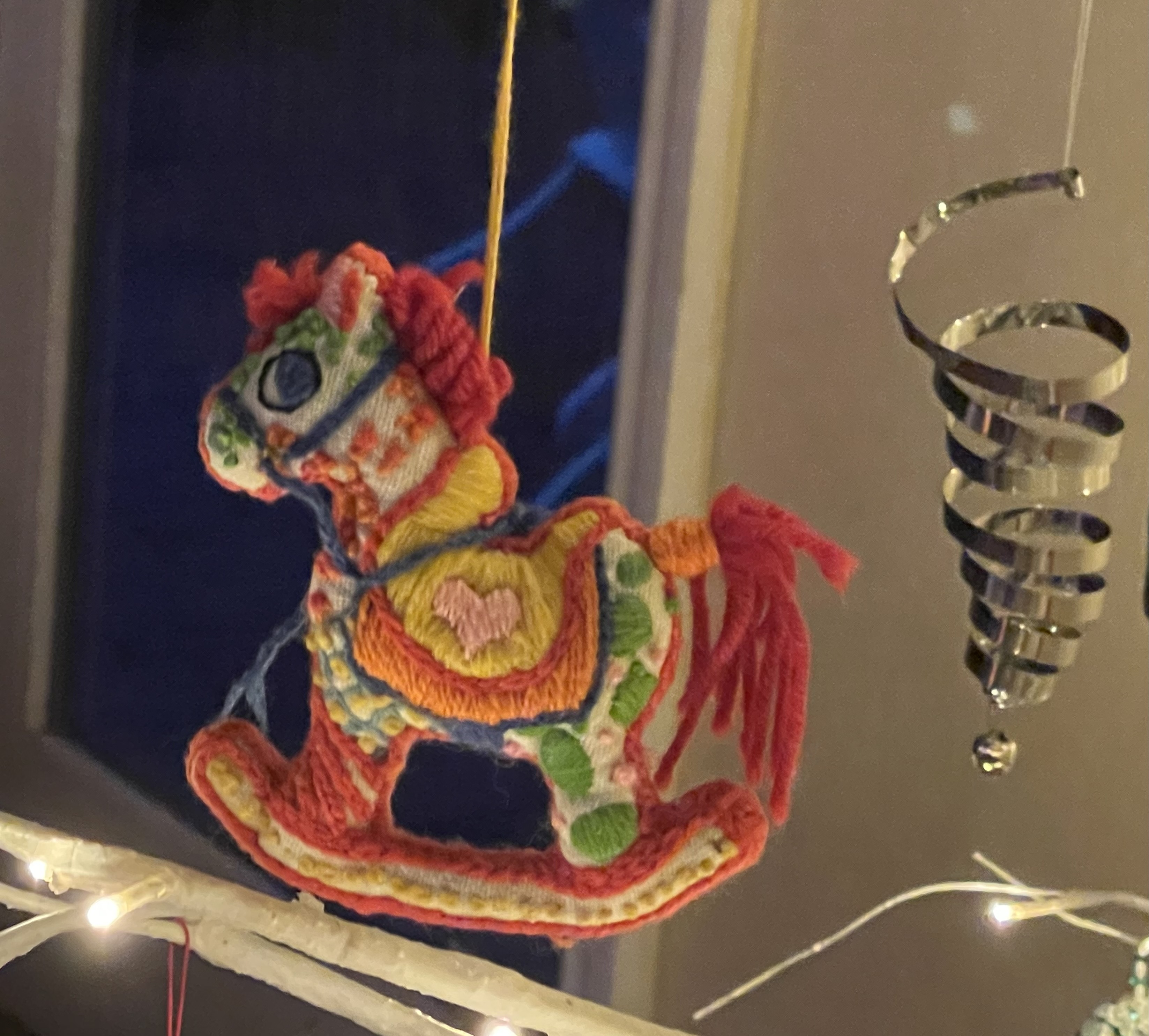
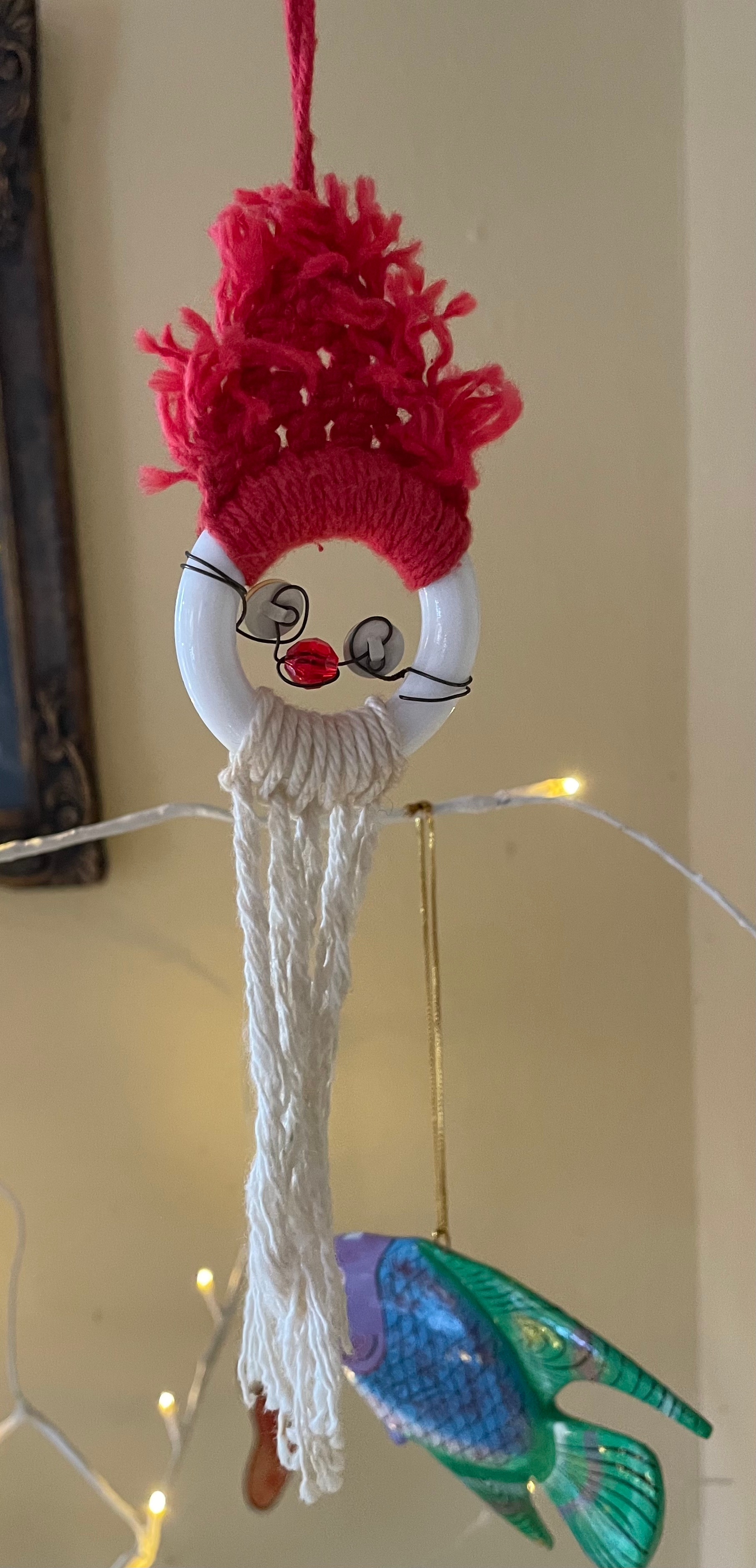
My favorite ornament
When and where I was a child, there was rarely snow at Christmas. My family lived too far from relatives to find uncles snoring like dolphins in the living room or aunties sneaking a few too many sips of the cooking sherry and breaking out in song. And we had only a few traditions: My sister and I always made chocolate fudge. She had self-control but I always ate too much and got sick to my stomach. Mother always made dates stuffed with walnuts and rolled in powdered sugar for our guests: Friends and neighbors who were also far from, or estranged, from family. But they generally arrived with bags of chips and take out pizzas, drank all the alcohol in the house and then left behind those dates.
And then, too exhausted to make a proper sit-down meal, we’d end the evening next to the fire, eating popcorn and listening to records. This song I always associate with Christmas Eve. I mean, who doesn’t?
My father was the grandchild of Norwegian immigrants. Their Santa equivalent is called Julenisse and he’s either a gnome or an elf or a troll and where do gnomes and trolls live? Deep in the woods or deep underground with all of those wolves who used to roam Wales!
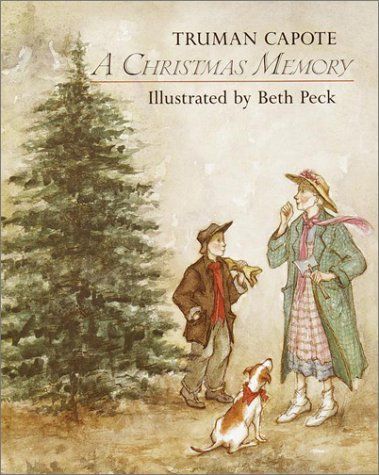
Next on my list of favorite Christmas stories that have nothing to do with Santa, is this short story by Truman Capote.
It’s the story of a young boy and his elderly “friend” who set out with $12.99 to make thirty fruitcakes for people who have been kind to them or people they admire (like Eleanor Roosevelt). They are the wards of “persons” who “have power over us and often make us cry” but who for the most part ignore them and so over the years they have figured out how to entertain themselves and, at the same time, save a few pennies here and there for their Fruitcake Fund.
"... a morning arrives in November, and my friend as though officially inaugurating the Christmas time of year that exhilarates her imagination and the fuels the blazes of her heart announces: 'It's Fruitcake weather!'"
We know little else about them. The young boy remembers no other home and his friend has never traveled more than five miles from the house nor has she seen a movie or eaten in a restaurant … but she “has killed with a hoe the largest rattlesnake ever seen in the county (sixteen rattles) … tamed hummingbirds (just try it) till they balance on her finger … knows the recipe for every sort of old-time Indian cure, including a magical wart remover.”
She also knows how to make kites and fly them in any weather. The important things to a young boy.
Nor do we know much about where they live except that it is a “spreading old house in a country town.” There’s an orchard nearby where they gather “windfall pecans” from amongst the fallen leaves, a grocery where they buy “cherries and citron, ginger and vanilla and canned pineapple from Hawaii, rinds and raisins and … oh so much flour, butter and so many eggs” which they load into his baby carriage (the thing he arrived in with little else) and drag home. However, for the most expensive ingredient they must summon their courage to visit a notorious bootlegger by the name of Haha Jones. Any guesses as to what that most expensive ingredient was?
Truman Capote aka Buddy and his friend Nanny aka Sook
Okay – it’s whiskey! Any of my baking blogger buddies use hard liquor in their fruitcake? I’m thinking of giving it a try. It’s been just that kind of year!
Me … after gobbling down too much spiked fruitcake.
Recap of the previous post: Daniel introduces the girls to his childhood friend, Marcia who works as a social worker and lives in a carriage house behind the Hari Krishna Institute. She agrees to help them.
By the time Daniel arrived at the gas station the next morning, the Volvo was gone, retrieved, his boss explained, by a couple of harebrained gals. Good, Marcia had worked her social worker magic. She’d either gotten them into some program or convinced them they were not prepared for life in the big, bad city and they’d left for home. That happy thought sustained him through a busy day spent fixing tires for teamsters (their only customers) and helping the boss keep his ledgers balanced. It would have been a good deed mentally rehashed for months. However … corned beef called, corned beef stacked on rye bread with sauerkraut and a drizzle of the kind of cheesy mayonnaise found only at certain delis. An indulgence he couldn’t afford every day but would be his reward. Corned beef on rye.
He savored the thought for several blocks, noting the cool October breezes as his stomach grumbled. Winter had come early and it would be a long one. He pictured the inside of the deli, the white-coated salami and barrels of pickles, as he turned onto Hudson Street. Maybe he’d eat just half the sandwich and give the rest to a street person, some poor soul seated on the curb or hunched in one of the alleyways
But it was not to be. Just outside the deli he ran headlong into two of the girls he’d rescued the night before: the ring-leader and the girl who reminded him of a young Eleanor Roosevelt. “I thought you guys left town.”
“Left town?”
“Or something.”
“Oh no – we’re going to stay with Marcia another night. Nora’s really sick. After you left, she began puking and she puked all night long! We’d finally gotten to sleep around FIVE in the morning! And this other guy showed up. A guy with a funny English accent and a really weird name.”
“Theron?”
“Yeah! So you do know him. He said you would. He called you ‘Daniel Beloved of God’ but he said it kind of sarcastically.”
“Oh my God Daniel. You look totally freaked out. Nora’s up there all alone with him.”
“What?”
“Marcia went to work. She told him he could sleep in her bedroom but had to be gone when she got home. Oh my God, is Nora in danger?”
“You should buy some chicken soup for your friend. Lou makes the best …”
“Daniel!”
“And it’ll cure … listen, Marcia wouldn’t have left if she thought Theron was a danger. But I’ll come back up there with you. I owe her an apology anyway.”
“Daniel, old man!” Theron said after he realized he was being watched and moved away from the Catholic’s daughter, who, despite being sick, had spread herself over the bean bag chairs suggestively. From the beginning Daniel’d been leery of Theron’s tall, dark and handsome movie star looks. It wasn’t jealously. Something was missing. Something, thankfully, Marcia had soon realized but then … she had more experience.
Daniel laid the groceries on the counter as the other two girls crowded on the floor next to their friend. “Where’s Marcia?”
“Oh my. Marcia has had a nasty day dealing with the wretched underbelly of Manhattan. She’s in the shower. And this lovely young lady,” he said with a wink towards a girl who was not much more than a child, has been entertaining me with the stories of their travels. Did you know they are from Reno Nevahda? Have you ever met anyone from Nevahda? Quite unusual really, one only thinks of Nevahda as the home to sagebrush and jack rabbits, now doesn’t one?”
“What are you doing back here?
Theron slid along the wall toward the door. “Oh you mean, why aren’t I in jail. Blimey,I’ve been alluding coppers since I was fourteen. They’ll never catch me. They don’t even know my name. Speaking of stories, that was rather funny this morning, wasn’t it girls?”
“It was four in the morning.”
“Sorry Luv. That’s when me shift at the docks ends. So funny, once they heard my English accent, they weren’t at all afraid of me. It’s those bloody Beatles. Made life ever so easy for us British blokes!”
“You work at the docks?”
“Longshoreman, we’re called.”
It was a ridiculous lie, so ridiculous that Daniel couldn’t help but utter a loud “Ha!”
“Why do you scoff, Mate? I didn’t have the benefits of a seminary education — a mother who thought I was the Second Coming. I’ve been on me own since I was a lad and, aye, I’ve had to do things I’m not proud of but haven’t we all?”
The rumblings of the first evening prayers sounded across the courtyard. Hari Krishna, Hari Krishna, Krishna Vishnu. Theron turned towards the Institute. “Oh my, they’re finished with their supper. That means it’s time for me to head off to work.”
“Are you coming back?” Daniel asked.
“I thought you didn’t live here any more, mate. I thought Marcia got tired of waiting for you to fuck her and kicked you out on your arse.”
The girls gasped.
Don’t respond. Daniel thought. He’s just trying to bait you.
Theron continued. “You’re such a funny old sod. This isn’t the bloody desert. You’re not the friggin’ savior and I’m not the devil. Although I do appreciate the honor of your, shall we say, compliment. But this place is rather crowded with all of us sharing only one rather stinky loo. I think I’ll crash somewhere else. Perhaps at your buddy Frank Frank’s. I hear they always have fresh blood,” he paused and then froze Daniel’s heart with a howl. “Look at Daniel’s face, girls! Hahaha!”
With that, Theron slipped through the door.
After he left, Daniel stepped over to the window but saw nothing in the courtyard. Only shadows. He unscrewed the cheap bottle of wine he’d brought and took a swig just as Marcia emerged from the bathroom.
“Oh good.Theron’s gone Can you believe that guy?”
“Maybe you should lock your doors tonight.”
She ignored him and addressed the girls. “I’ve been thinking. We should call your parents. I bet they’re worried sick about you.”
“Oh yeah. Tell them their daughters are hunky dory. They just spent the day with the Devil.”
“Shit, Daniel! No wonder the girls look so freaked.”
“He killed someone.”
“The police weren’t sure. Besides I don’t want to talk about him anymore. He’s not coming back.” She noticed the bag of groceries.
“Forgive me?” Daniel hadn’t slept the night before. His sole window at the Y was cracked and provided little protection from the rain or the sounds of the city. The walls were so thin he could hear a fellow transient snoring in the next room. Five years he’d spent in New York City practically homeless, figuring it would free him. But it hadn’t. And so the wine quickly gained on him until a dizziness ⏤ borne of eating little and guzzling cheap wine ⏤ soon overcame him. He slumped into one of the bean bag chairs and closed his eyes. He could hear the girls on the phone. Yes, we’re okay. Yes we’re going to Grandpa George’s first thing tomorrow morning. Further and further away they slipped until either he or they were gone.
Two more episodes! Have you guessed the ending? I doubt it!
I guess it’s time to finish posting the story of Daniel and the three girls he takes under his wing on the mean streets of New York City. I’ve been dragging my feet because it’s hard to shift gears from paradise to the Bowery circa 1969 but, I try to finish everything I start, so here goes …
First to recap:
A woman named Sandy has been invited to an art exhibit/memorial for a childhood friend. Once there she’s told by the woman’s son that, although the two women had drifted apart, there was something in each of his mother’s final and very disturbing paintings that she specifically wanted Sandy to see, a face from long ago. October of 1969 to be precise.
Flashback to a rainy evening in October 1969. The scene is a service station in Manhattan’s notoriously dangerous Bowery. Three young women drive up to the pumps and, spotting a young man in the phone booth, plead with him for help.The young man, Daniel, is an enigma: an intelligent and well-educated young man but a drifter. Although he works at the station, he cannot help them because the owner has shut down the pumps and left for the night. Then he remembers he has a friend who, at one time lived not far away, in a place of relative safety.However, getting there proves to be a challenge when a “behemoth” drags one of the girls back into an alleyway. Daniel, who is half the man’s size, is powerless to stop him. The girl waves a crucifix in the man’s face which causes him to roar with laughter and lose his grip on her.
Finally they reach the street his friend once lived on. The rain has let up but they have one more obstacle.
It’s hard to believe we are teetering on final quarter of the year. For me, it’s time for reassessments. Am I going to accomplish what I set out to do in January? Generally the answer is “no” which leads to the question: What can I accomplish before the end of the year without turning into a basket case? I’ve been told that’s one of the pitfalls of being an eldest sister. Eldest sisters, particularly those with working mothers are overly responsible, goal-oriented and guilt-ridden when failing to meet their goals. But you know what? I think I’m on the mend. Perhaps it’s age.
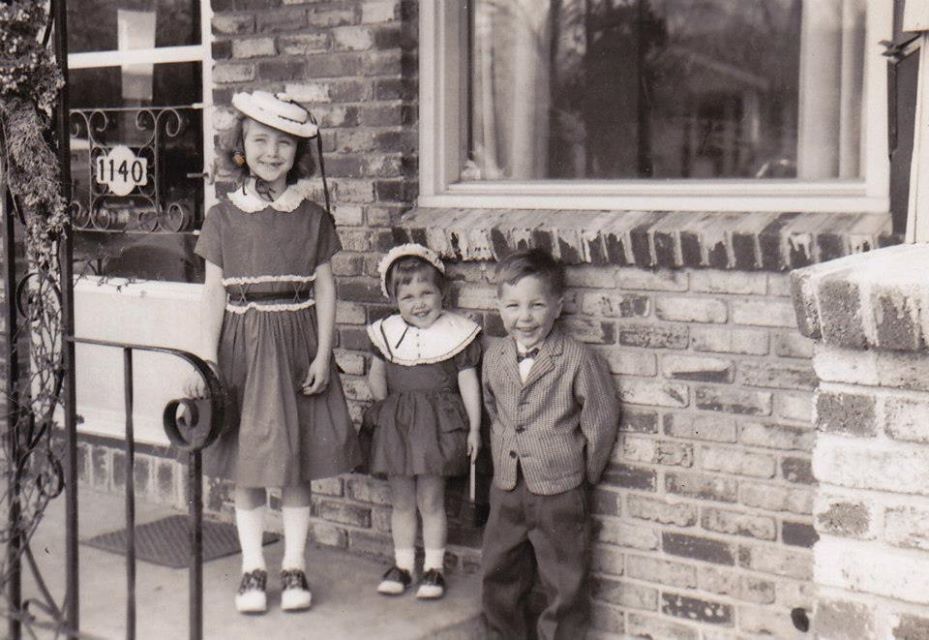
Note the little devils I had to put up with! Forget those impish smiles. “You’re not my mother!” was the only thing they could say.
For example, this year I vowed to:
Collect my stories and edit, edit, edit the crap out of them
Get more involved with the community
Hire a gardener; a handyman; and an electrician
Bronze a few of my sculptures with money my mother left me for such a purpose
Republish my second book.
Of all those lofty goals, I accomplished just one. The last one.
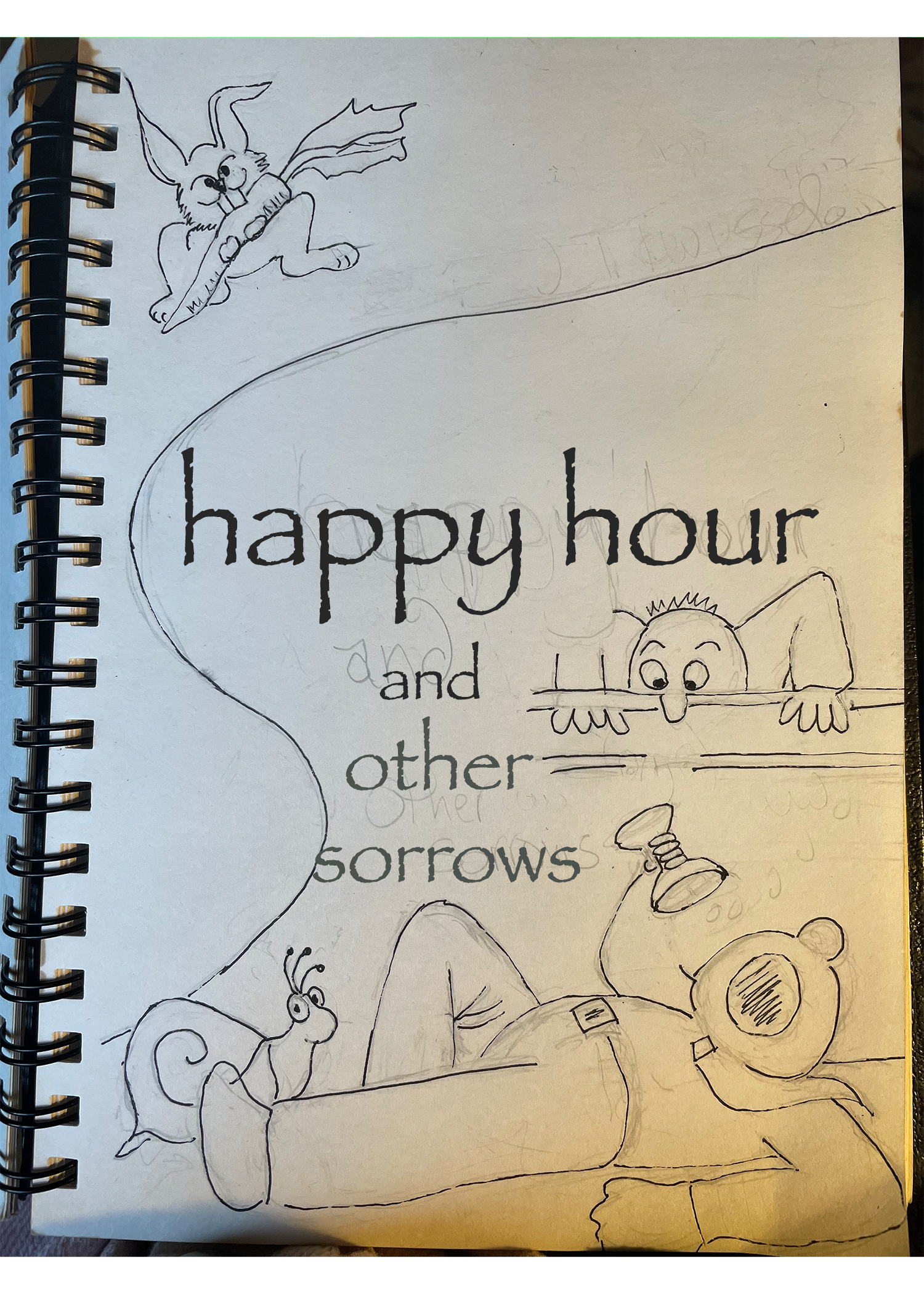
One of the dozens of sketches for the book. I learnt this year that I am not a skilled cover designer!
I must admit, it felt good to release the story to the world. Really good, considering that I began writing about the wacky world of mein Oncle Boob over thirty years ago.
As for my other goals, well the world will not end if I don’t finish them. It might end … considering how everything is going … but it won’t be because I did not hire an electrician.
Tomorrow I flip the page to a new month on the Wasabi calendar. Any guesses as to which flowering. plant is featured? Here’s a clue: it’s native to Japan where it is considered a great delicacy.
The other day, when asked during an interview what sort of person annoyed me I said a nosy person which was a hypocritical thing for me to say considering that I am a writer. And what do writers do? They stick their noses into everything!
Sunrise over my neighbor’s driveway
Which begs the question: Where is the line between nosiness and curiosity or is there one? Here is an example of the what I mean:
Two women have been living next door to each other for a dozen years. They are friendly but not necessarily friends. We’ll call them Mrs Green and Mrs. Yellow. One day a strange car shows up in Mrs. Yellow’s driveway and stays for three whole days. Mrs. Green is curious. She imagines all sorts of scenarios.
Finally one night Mrs. Green bumps into Mrs. Yellow at their mailboxes and says: “I noticed there’s a blue car sitting in your driveway. Is everything okay? Did you get a new car”
To which Mrs. Yellow responds: “My nephew is staying with me for a while.”
At this point Mrs Green, if she were merely curious, could say something like: “How nice. I hope you have a lovely time together.”
Mrs. Yellow is then free to share that her nephew is relocating or that her nephew is getting over a bad breakup or that her nephew is an escaped convict but she doesn’t. She merely smiles and says: “Thanks.”
However if Mrs. Green continues by asking: “How old is he? Is he a registered sex offender? Why is there a dent in the side of his car?” She is being nosy. Although perhaps there is a better word. What would you say?
I will use any excuse to post pictures of my neighbor’s beloved Gaston. He’s gone but certainly never forgotten. He could be very curious and even a bit nosy but I never minded a bit! Dogs can be a nosy as they want!
Of your unspoken word you are the master; of your spoken word the servant; and of your written word the slave – Quaker proverb
Writing is easy all you have to do is cross out the wrong words. – Mark Twain
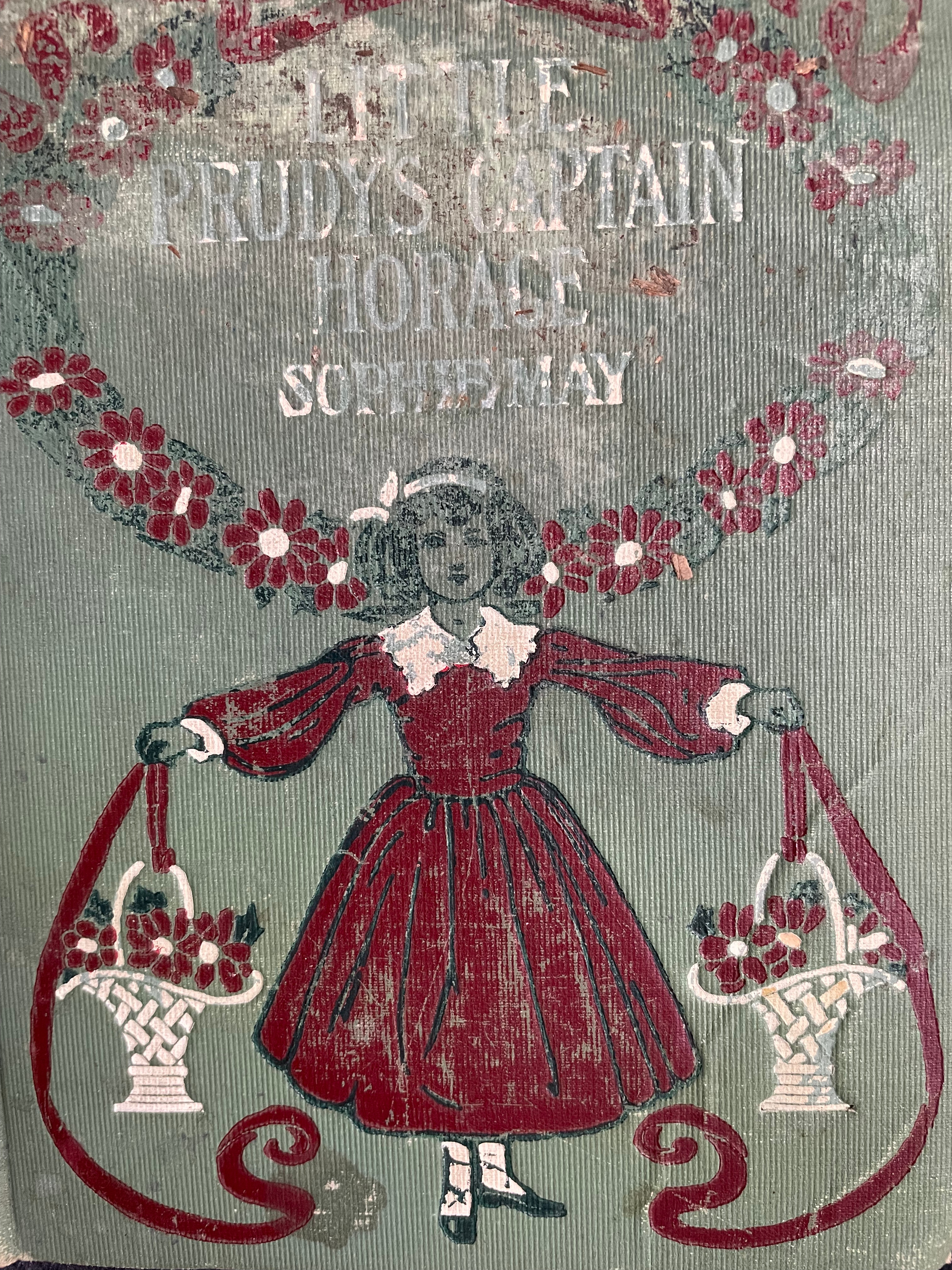
Any guesses as to who was known in the late 1800s and early 1900s as “The Charles Dickens of the Nursery”? Probably not, unless like Yvonne of the Priorhouse blog, you’re a fan of old and dusty books.
Little Prudy’s Captain Horace, circa 1863. Before you get the wrong idea, Captain Horace is boy who dreams of being a captain. Not some sort of middle age pervert stalking Little Prudy.
It was Sophie May, the pen name of Rebecca Sophia Clarke who spent her entire life in Norridgewick Maine (or perhaps Norridgewock. River Gal, perhaps you know?) Like Dickens, her stories started out being published in magazines such as The Congregationalist and Little Pilgrim where they were considered more realistic than the moralistic children’s tales of the day. Her most popular series was The Little Prudy Series.
M.A. Donohue & Company published high quality children’s books until the 1960s! Now they are more famous for their building on Printer’s Row in Chicago.
I have, in my collection of damaged and dusty, water and coffee stained, and undoubtedly worthless books … two Miss Prudy books. They belonged to Helen Nelson, my maternal grandmother.
Aside from Miss Prudy, described by her creator below:
Miss May also wrote about Dotty Dimple (who seemed to be quite the adventuress), Flaxie Frizzle and the Quinnebasset Sisters.
However, I was a little shocked to find this notation in the back of the book.
Did my grandmother fail to return a library book? Heavens, what would Flaxie Frizzle have thought?
Also belonging to my grandmother were a couple of books by Edgar A. Guest (1881-1959). Anyone care to guess what he was known as?
Aside from:
“The last man in the world is Edgar Guest”
Internal monologue of Robert Neville in I Am Legend, by Richard Matheson.
For years now I’ve been following Bojana Stojcic whose work has been published in a whole slew of online magazines. Recently she pulled together a collection of her short short and flash fiction pieces for DarkWinter Press, an independent publishing company located in Ontario Canada that wants “your weird, your traditional with a twist, your humour, your dark thoughts, or your elation. We’re open to anything—just make it interesting. Make us think.” They certainly hit the ball out of the park with Bojana. Her work does all of those things.
Imagine, if you will, Bojana and I are sitting at an outdoor cafe in Munich, which is her current home, discussing her book.
From Bing Images
Jan: Thank you for stopping by for tea to discuss your new book! I must say, you look divine. Not at all the frazzled writer! As I was reading your book I kept thinking: this writer is a chameleon who’s not going to let readers pigeon hole her work. At times, wise and witty (“today I am a future pile of dust like you.”) and at other times raw to the bone (“I need evidence that I’m alive.”) Is there a writer with whom you most identify?
Bojana: There are a lot of writers I look up to but, rather than identifying with any particular writer, what matters more to me is to identify as one. Writing doesn’t come easily to me. I know some people who write prolifically, whether it be essays or blog posts or poetry. I’m not one of them, although that doesn’t stop me from wondering what specific mindset allows someone to write that much. Then I find comfort in the thought that fiction requires a somewhat different approach. An author summed up writing fiction beautifully: the first draft is like getting lost in the woods, editing is your map and revision finding your way back out. And, to quote Robert Frost, “The woods are lovely, dark and deep.” It’s easy to get lost in them.
Writing means observing, listening, reflecting. It also means research and regularity. Most importantly, to be a writer, you have to read like one, which is precisely what I do. As someone who is more curious about how than wow, I analyze instead of getting lost in the story. I study characters thoroughly, reread interesting dialogues, monologues and descriptions, I pay attention to the sentence structure. Finally, I contemplate the word choice to better understand the motivations and conflicts. I need to think long and hard about every single detail, always keeping in mind the emotion I’d like to provoke. I need my readers to feel the horror, envy, anger. I want them to grieve with my protagonists, to ache with them, to be equally disgusted or brokenhearted or utterly apathetic and withdrawn. Like in real life. It’s easy to judge. What’s way harder is to understand someone’s reluctance to make any effort to change or improve things. To show compassion and a willingness to believe that choosing pain doesn’t always mean making the wrong choice.
Jan: Is there an example of what you mean in one of your stories?
Bojana: Yes. In Once You Have a Duvet, You’ll Be Fine
You begin to feel it at a young age; your body gives you signs so you damage it once, you damage it twice, too many times to remember. Because you don't know a better way to cope. Roll with it, they say, like a ship in a storm. I wish I could say, I tried but it didn't work. Truth is, I didn't. Like a letter thrown into the fire,I darkened and curled before bursting into flames.
Jan: You hear a lot about flash fiction these days, but how is it different from short stories and does the genre have anything to do with the title of your book? You know, knives cutting like editors editing?
Bojana: For the record, I came up with the recurring knives and blades symbolism after I’d written at least a dozen stories, when I realized I could be actually working on a book. The thing is, I needed a strong metaphor, some sort of a unifying idea which would put together seemingly dissimilar things and, since I’m a huge fan of everything chilling and eerie in storytelling, blades seemed like a good choice, as they only further stressed the emotional turmoil and expectations the protagonists had to cope with.
Back to flash fiction which is actually a shorter version of a short story, its length normally not exceeding 1,000 words. Plenty of editors/publishers are pretty specific about publishing one, but not necessarily the other, which is why I like to call Knives All Blade a collection of short stories and flash fiction. Let’s put it this way: flash fiction tries to tell big, rich, complex stories quickly and concisely, each word carefully chosen to convey emotion and atmosphere. For me, telling a story compressed into limited language, without wasting time or space, is what’s most challenging about it.
One of the keys to flash fiction is a sense of urgency. The point is to start in medias res, to throw readers right into the thick of it. This creates a sense of immediacy and helps build tension, as it raises questions that readers will be able to answer only if they go on reading. I enjoy writing intense, gripping stories, pulling readers by the heart without releasing tension from the beginning to that climax, every scene compelling them to hold their breath or stop breathing altogether. It’s a process. It takes time to learn the ropes. To learn how to build tension and when to slow things down, how to effectively use a mix of long and short sentences to communicate the protagonists’ thoughts and feelings, how to surprise the reader, write a story that inverts themes.
Jan: Can you give us an example of what you mean by sense of urgency and stories that invert themes?
Bojana: Here’s an example of urgency from Life to the Throat
A knife will always manage to surprise you, like your period," I told my little girl, giving her one as a gift when she started bleeding. "That blood running prepares you for pregnancy. Learn how to use it."
I wish I'd had one. I was so confused.
Regarding “inverts themes” that would be hard, if not impossible, to name an example here because the twist/resolution happens literally in the very end, so you’d have to know the whole story to understand. A good example would be Beyond the Ditches when you come to realize it’s not a story about the challenges of being a mother, but about childlessness. (It was all in her mind, making up the kid as either a copying mechanism or impact of trauma.) Or, say How to Skin a Dogfish when zio Luigi becomes a likely murderer and we see that K is actually a parrot, not a child. Or maybe Once You Have a Duvet … again.
Unknown to her, a letter arrived from court in late January, saying an eviction order had been placed on the house, that she had seven days to leave the property. Her husband stopped paying the mortgage, full of surprises as ever. All the while she waited for him under a tree, blossom-fringed branches bowing toward the ground, as if begging for forgiveness. Waited with bated breath to say I tried so hard to stop the situation getting this far, to see what he would say about her leaving him.
Flash fiction isn’t plot-heavy, thank god. It’s all about capturing moments, and sparking the imagination, which enabled me to put more emphasis on character development. That being said, each story required a different approach. And yes, some were definitely more difficult to tell than the others. It wasn’t always easy to translate all those images and ideas into actual words that carried a story along. That’s something I had to learn as well. To stop fretting about details or editing every little thing. The first draft is ugly for a reason.
There’s more to it, of course. If I didn’t know enough about a subject, for example, I would do research, go back to reading. Slowly and critically. This also included reading relevant books, news, articles, blogs, etc, as well as essays on human behavior to better understand personality development and create believable stories and layered characters that the reader can relate to. Writers need to understand people because we write for people, about people.
Jan: Yes indeed. Thanks for stopping by and spending some time with me. I hope that Knives All Blade will get the widespread attention it deserves.
Lovely Readers, I know many of you write flash fiction, do you have any questions for Bojana?