Any guesses as to who was known in the late 1800s and early 1900s as “The Charles Dickens of the Nursery”? Probably not, unless like Yvonne of the Priorhouse blog, you’re a fan of old and dusty books.
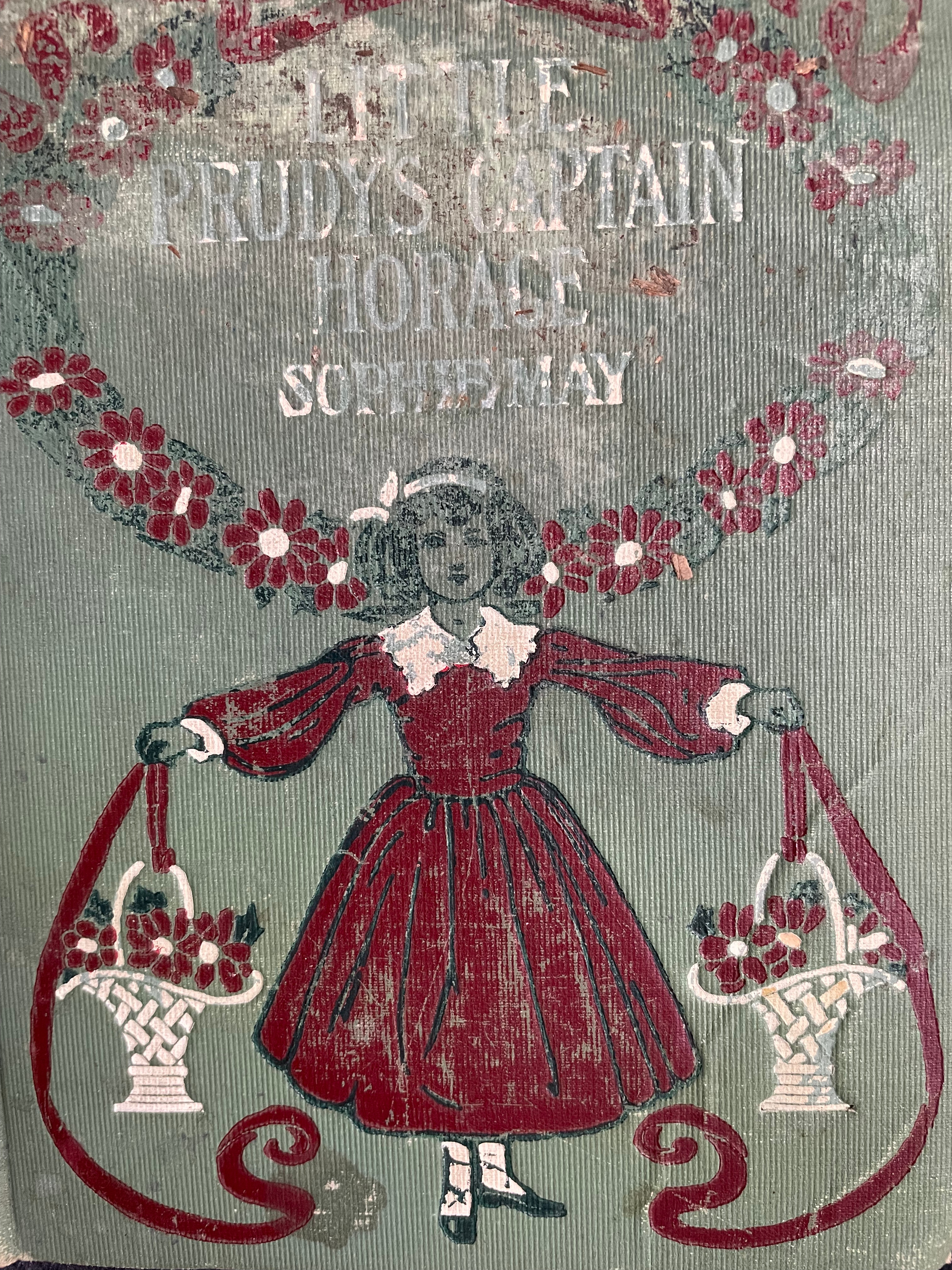
It was Sophie May, the pen name of Rebecca Sophia Clarke who spent her entire life in Norridgewick Maine (or perhaps Norridgewock. River Gal, perhaps you know?) Like Dickens, her stories started out being published in magazines such as The Congregationalist and Little Pilgrim where they were considered more realistic than the moralistic children’s tales of the day. Her most popular series was The Little Prudy Series.

I have, in my collection of damaged and dusty, water and coffee stained, and undoubtedly worthless books … two Miss Prudy books. They belonged to Helen Nelson, my maternal grandmother.
Aside from Miss Prudy, described by her creator below:

Miss May also wrote about Dotty Dimple (who seemed to be quite the adventuress), Flaxie Frizzle and the Quinnebasset Sisters.

However, I was a little shocked to find this notation in the back of the book.

Did my grandmother fail to return a library book? Heavens, what would Flaxie Frizzle have thought?
Also belonging to my grandmother were a couple of books by Edgar A. Guest (1881-1959). Anyone care to guess what he was known as?
Aside from:
“The last man in the world is Edgar Guest”
Internal monologue of Robert Neville in I Am Legend, by Richard Matheson.
 Saying nothing in particular
I know you do not really join in with photo challenges – but this post would be a perfect fit for the Lens-artist’s theme this week: https://sillarit.com/2025/05/31/lens-artists-challenge-351-books/
A very interesting post – thank you for the suggestion. Did you leave a link? I’ll have to check it out.
Wow, what a fun post! Thanks for linking me because I might have missed this post – and I am so glad I did not. For example, seeing the sign out library card from 1920 – I had not idea that they had this system in the early 1900s and thought it started in the 50s – so we keep learning. And, I do wonder if she forgot to bring it back? I wonder the story.
Alos, Dotty Dimple, Flaxie Frizzle. Quinnebasset Sisters – how fun to learn about this playful titles/names.
I can’t imagine my grandmother not returning a library book – she lived in a town of less than 400 people and everyone knew everyone else. Sophie May apparently never traveled or married or had kids – her role models were nephews and nieces.
:0
Dotty Dimple? Flaxie Frizzle? Talk about names from the past! Leave it to Yvette to turn you onto them. 😊
Sophie May’s writing style is quite chummy – it’s like she’s sitting across from you telling a story. At times I had to cringe – her views on the world were based on common misconceptions of the time. But that was over one hundred years ago.
Perhaps the library got rid of the book. Ours do that periodically, making it a chance for those of us who love books but don’t want to pay full price, to score a bargain. 🙂
However, I recently bought a book from the author rather than on Amazon, so that she got the entire amount, not just a little.
janet
That’s possible. The book, when new, would have cost 75 cents but that was a lot of money back then. I’ve been to the library in that small town – it’s an old stone building in the center of town that was so crucial for the primarily immigrant families living there, as you can imagine.
“I’d rather flunk my Wassermann test than read a poem by Edgar Guest.” Dorothy Parker
In the interest of pubic health, or at least what passes for public health theses days, I felt compelled to share Dorothy Parker’s estimation of Edgar Guest. As someone who has had syphilis, I don’t really agree with Parker on this one. Give me any kind of poem over getting syphilis, no question. I am firm on that. Duke
I’ve read a bit of Guest and it’s a bit like listening to Mike Johnson. I think the guy must have been bipolar.
The fine for that overdue book is about $20,000 by mow!
True! I better not return it – they’ll put me in the pokey!
Ahh, this is a lovely post, Jan, thank you!
As to the possible unreturned library book – I inherited a slew of books from my M-i-L. Many had the return date chart in them. I thought the same maybe, as you. I began returning them to the library in the return chute.
Turns out she bought them over the years at library book sales! 🤭
I’m sure you’re right. There’s not much demand for Miss Prudy books!
You know, Jan, there’s not much demand for everything I own that I think is worth lots of money.
I checked. It’s not worth the time to sell it, so I might as well keep on enjoying those things, and giving them to others who will glean from them.
What a lovely post, I do like the look of books well read. And I am with the others, maybe bought from a library sale, and I am sure no big crime was done either way.
Thank you Ritva! If I even suggested my grandmother had failed to return a library book she would have hit me over the head!
😊
Such old books are full of secrets.
I particulary like bumping on a cooment, some association etc.
I think the covers of the Miss Prudy books were meant to look like needlepoint.
My sister still writes comments down on everything she reads. First she underlined specific words and comments, using different colored pencils, then started drawing exclamation marks, then moved to geometric figures. I used to say her notes and books looked like road maps only she knew to read.
There’s a story there in itself! Actually I’ve been kind of stuck on Flipka and you’ve given me an idea. Many thanks.
❤️
Did your grandmother fail to return a book? Hush, hush… Compunded fines over a century must be steep.
I think she probably bought the book at a library sale. She would never not return a book on time!
Most likely. My father was like that. Though he did buy a load of books when the Alliance Française library closed.