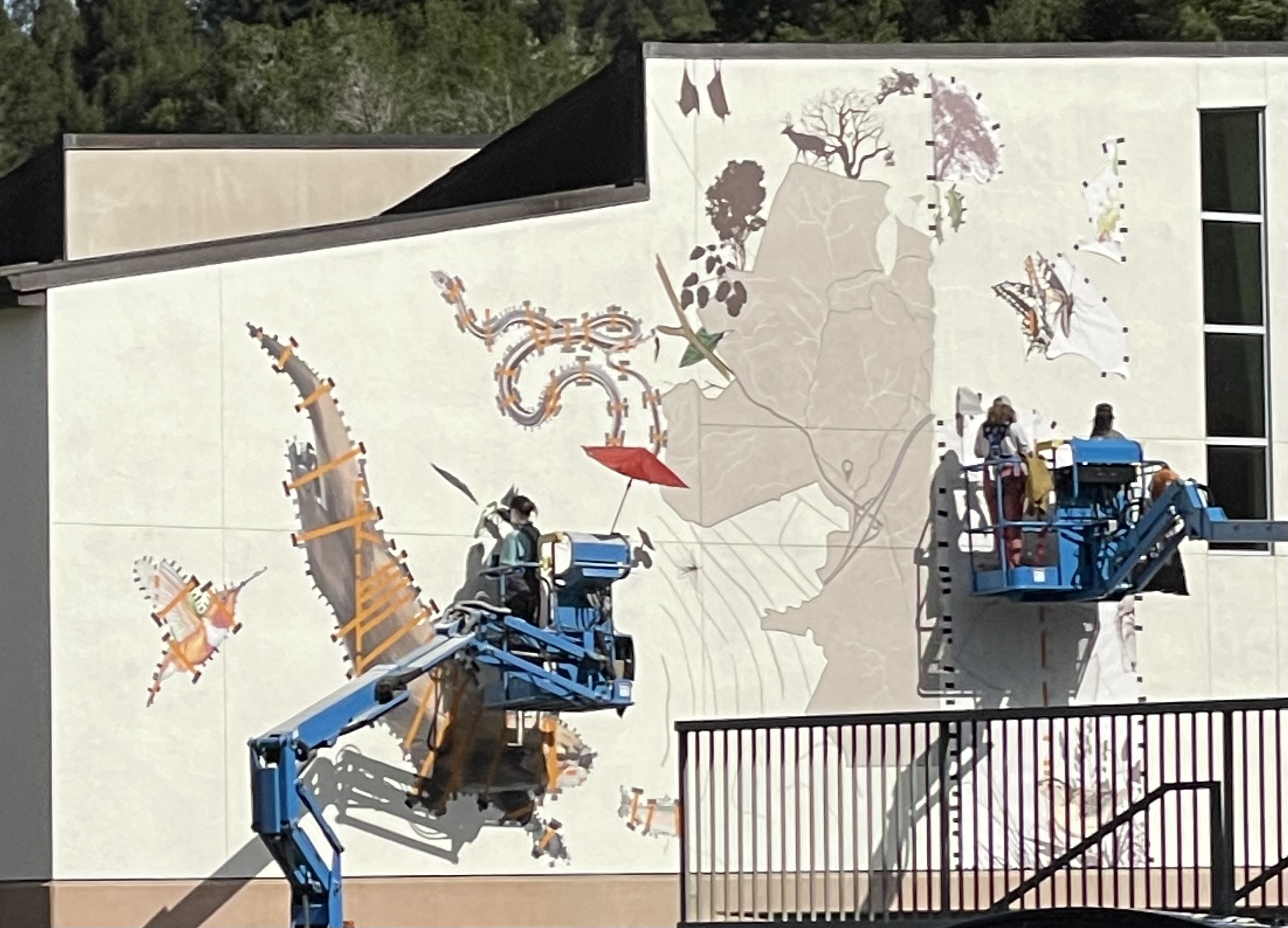
Mural on the side of the library, April 7, 2022The same mural April 24, 2022
Notice something missing? The giant otter! What happened to him, do you think? I doubt he swam away although we did have a spat of rain. Perhaps he washed away. Perhaps the artist changed her mind. Perhaps the town council didn’t want the town associated with a giant otter. Who knows?
However, we can see the snake more clearly now. Not sure where he’s going. The roof? It’s all a mystery folks!
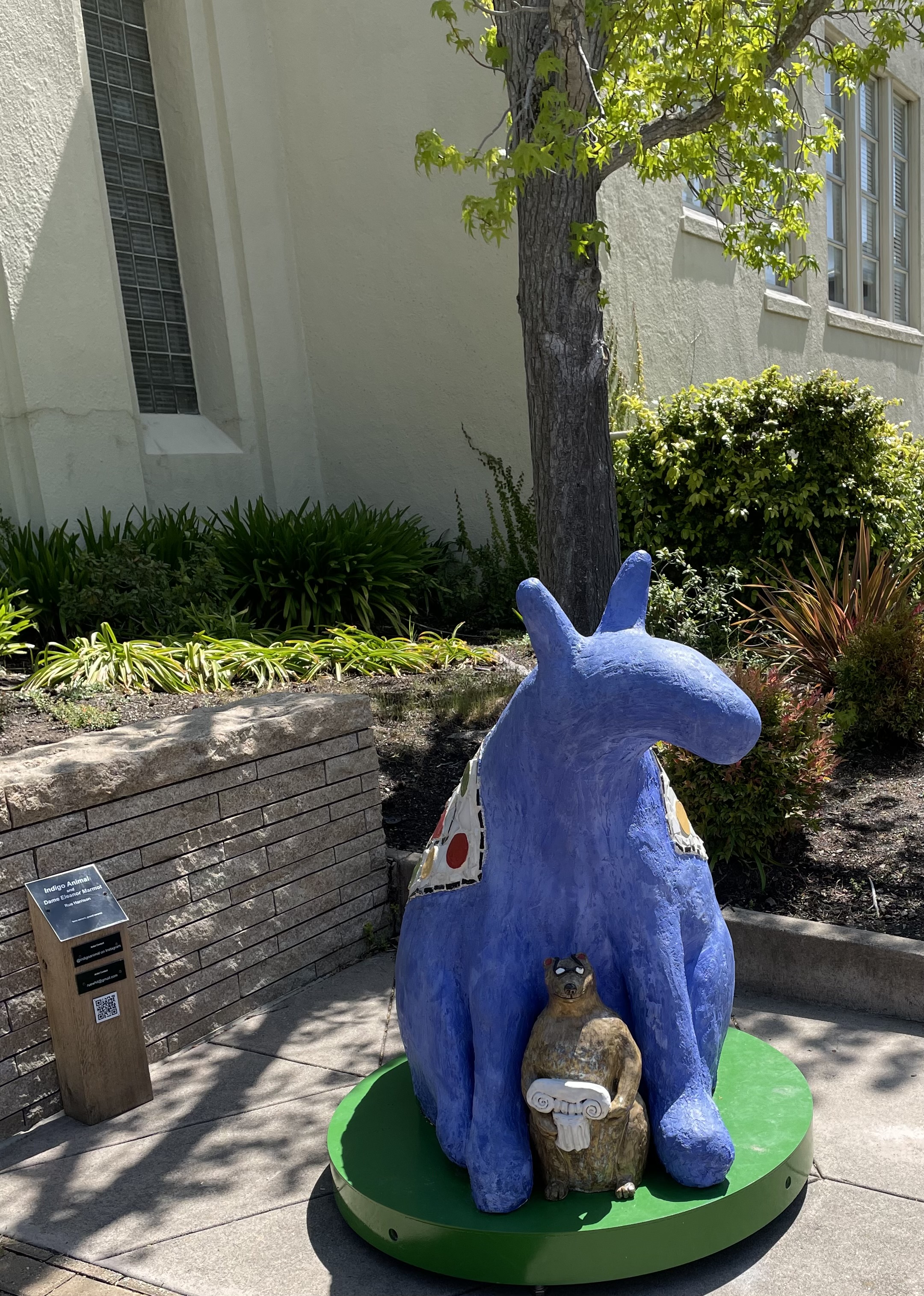
And in front of the Community Center, a new statue. This one is entitled “Indigo Animal and Dame Eleanor Marmot.” This statue is based on the Indigo Animal Trilogy written by Rue Harrison, a psychotherapist and artist living in the SF Bay Area. Indigo is a lawn ornament and Dame Eleanor is sort of a mother figure (or power possessing figure) to him. The author based Indigo on her own forays into the subconscious. All … very interesting.
Meanwhile I’ve been watching “The First Lady” series on Showtime. The first season is focused on Eleanor Roosevelt, who held the role during the Depression, Betty Ford, who had to take over the role after Nixon’s sudden resignation, and Michelle Obama, the first African American. All three women were far too accomplished to allow the men running the White House to tell them how to behave or what to say. It’s a joy to watch.
Easter Sunday Grandma took a ride on a roller coaster with Santa Claus. She chose Santa as her companion over a zombie and the Green Hornet because she always wanted to ride in Santa’s sleigh, however the sleigh cost extra and so she was asked to choose between Indiana Jones’ jeep or the Batmobile. She chose the jeep because the roller coaster was going through Jurassic Park and it just seemed more appropriate. Plus Grandma doesn’t like cars that ride low to the ground, particularly if she’s going to be encountering brontosauruses. She and Santa might end up squashed like bugs. “Do you want to shoot the dinosaurs?” They asked Grandma. “Not really!” She said. “Ho, ho, ho!”
Grandma looked to her right and there sat Santa Claus staring blankly at her. “Reach out and touch Santa, Grandma!” But when she reached over her arm turned into pink plastic and twisted like taffy. She’d become a friggin’ Barbie Doll! Granny Barbie, that’s what she was! One of her “fingers” touched Santa and he said “Ho, ho, ho” but didn’t change his expression. “Take the stick, Grandma and see what it will do.” They put the stick in her plastic hands and she pushed the buttons. The ride started. “If you get dizzy, shut your eyes.” “Ho, ho, ho,” said Santa as they began rolling over green hills. Here and then raptors trotted across the fields nipping at each other as the jeep bounced along. A very serene scene and then … “Whoooooa,” said Grandma as the jeep suddenly dropped into a deep canyon.
The skies grew darker and suddenly they were in a jungle where boa constrictors and tarantulas hung from the trees. “Ho, ho, ho,” said Santa as Grandma pressed more buttons and there were small explosions. Well, these buttons aren’t worth a fig! Grandma thought a they emerged from the jungle and headed for a cliff. “Holy Cow,” Grandma said aloud as the jeep became airborne and they flew through a sky filled with pterodactyls and other flying dinosaurs whose names Grandma didn’t know. “Ho, ho, ho,” said Santa, as they tried to bite off his head.
By now Grandma’d had enough of Santa. “Shut up!” She told him. “Ho, ho, ho,” he responded still smiling like the bloody idiot he was! “We’re in mortal danger and all you can say is “ho,ho,ho.”
The jeep was on a track again, this time moving rapidly backwards while being chased by snapping Tyrannosaurus Rexes. “Ho, ho, ho,” said Santa as they grew in size and surrounded the now dead Jeep, snapping and growling and barring their teeth. “I guess we’re goners,” Grandma said and guess how Santa responded?
“How did you like the ride?” They asked Grandma as they removed the goggles from her head.
“Well, I’m not going with Santa again! I think I’ll take my chances with the zombie instead.”
The first year I lived in Northern California it rained all winter and far into spring. I was a young mother in a new neighborhood. The neighbors were nice enough but I had little in common with them. The rain often came down in torrents, turning the road in front of the house into a river. I prayed for the rain to go away but it just kept falling. Gradually the sun came out and I ventured from the house, met like-minded people and went back to school. But I can still remember those long and lonely days of April.
Decades later … it’s early April with only the possibility of light rain showers in the future. We need rain. However, given the fact that fire season will soon be upon us, it’s silly to stay inside when the air is clean and pure.
The mural being painted on the side of our library. So far, I’m not seeing the vision, are you?
When I lived in Europe (1970), Johnny Hallyday was a like a god to the French. You couldn’t go anywhere without seeing his face on a magazine cover or hearing one of his songs being played. But I knew nothing about the man himself.
So the other day while waiting for the AAA guy (gremlins broke into my car while I was sleeping, turned on the overhead light and played cards, or some such nonsense, and completely ran down the battery!) I watched the Netlix series on him. Holy Cow, if you want to know what it’s like to spend most of your life being treated like a god, every personal moment photographed and talked about, watch this series. Ugh. It was such a grim slog through countless interviews with an obviously troubled soul that I almost gave up. But I’m glad I watched to the end because, finally, finally, he did start to feel comfortable in his own skin.
April 15th: I’m happy to report that we did get rain with more on the way. But I’m a long way from ever praying for the sun again.
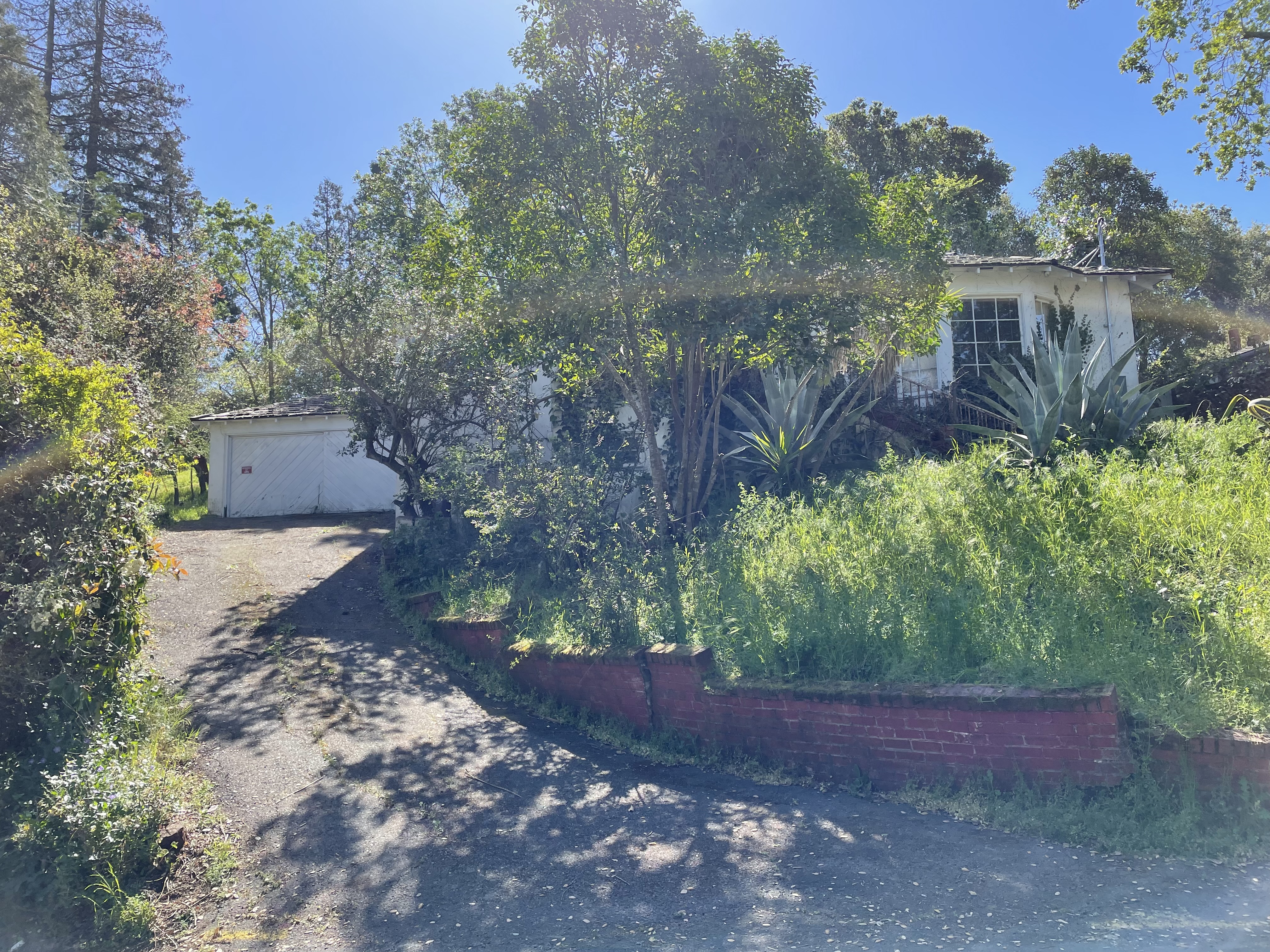
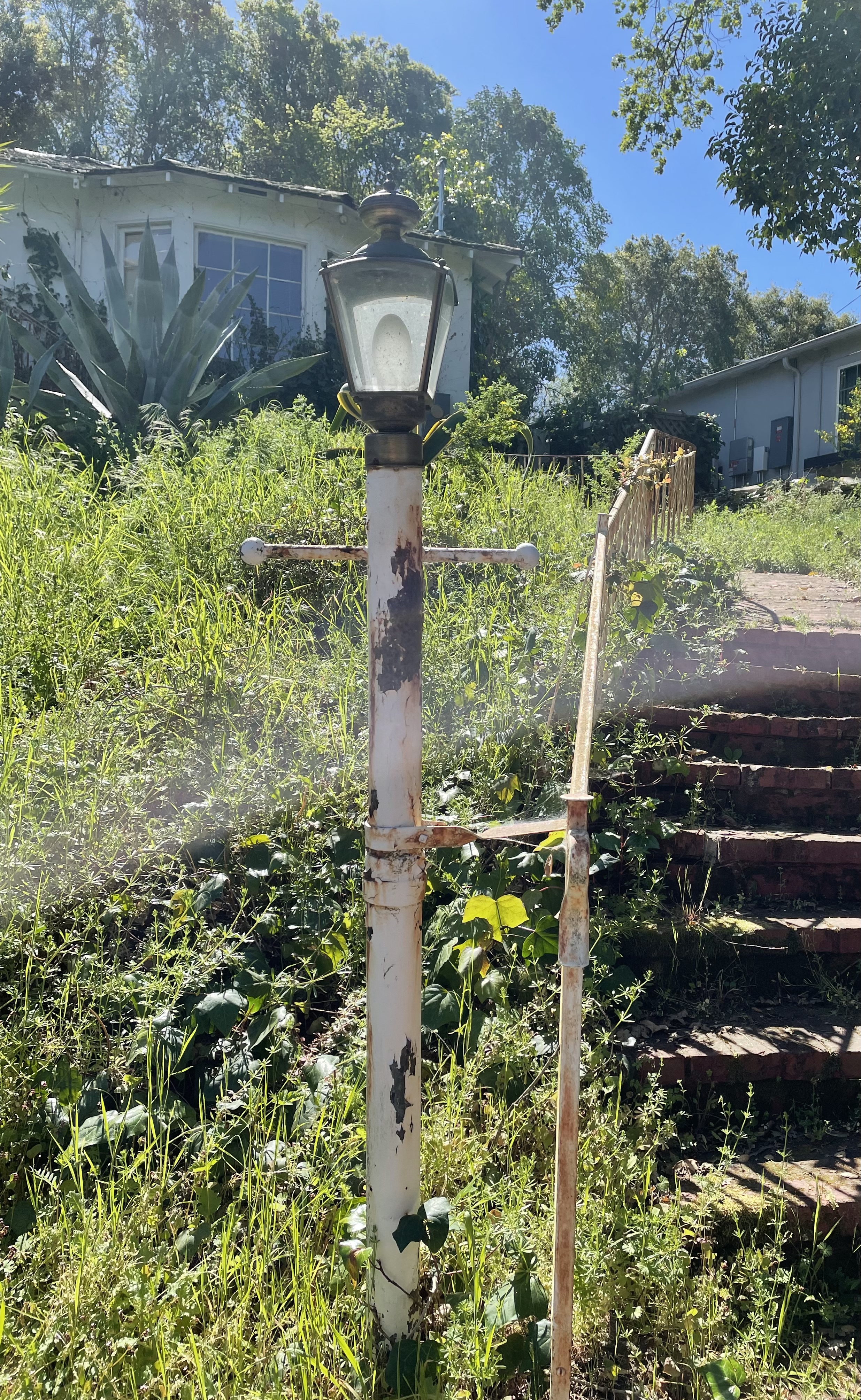
In my neighborhood, for a cool million dollars you can buy a dump.
Of course, it’s not really a dump. It’s just neglected and so old and out of date that whoever bought it will probably tear it down. I walk by this house almost every day and it’s always shrouded in ghostly light.
Like a dwindling number of bungalows in my neighborhood, it was built in 1938 and has two bedrooms and one bath. And a detached garage with a sign that reads “Beware of Dogs.” The other day the power company was on scene detaching the electric wires and cutting off the gas so soon, very soon, it will disappear. Because it’s sitting on a fairly large lot, what arises from its rubble will probably be a monstrosity. A very expensive monstrosity with a view of the freeway. The real estate market is insane.
There’s something tragic about walking past an empty lot where a house once stood and so I have started walking to the other side of town.
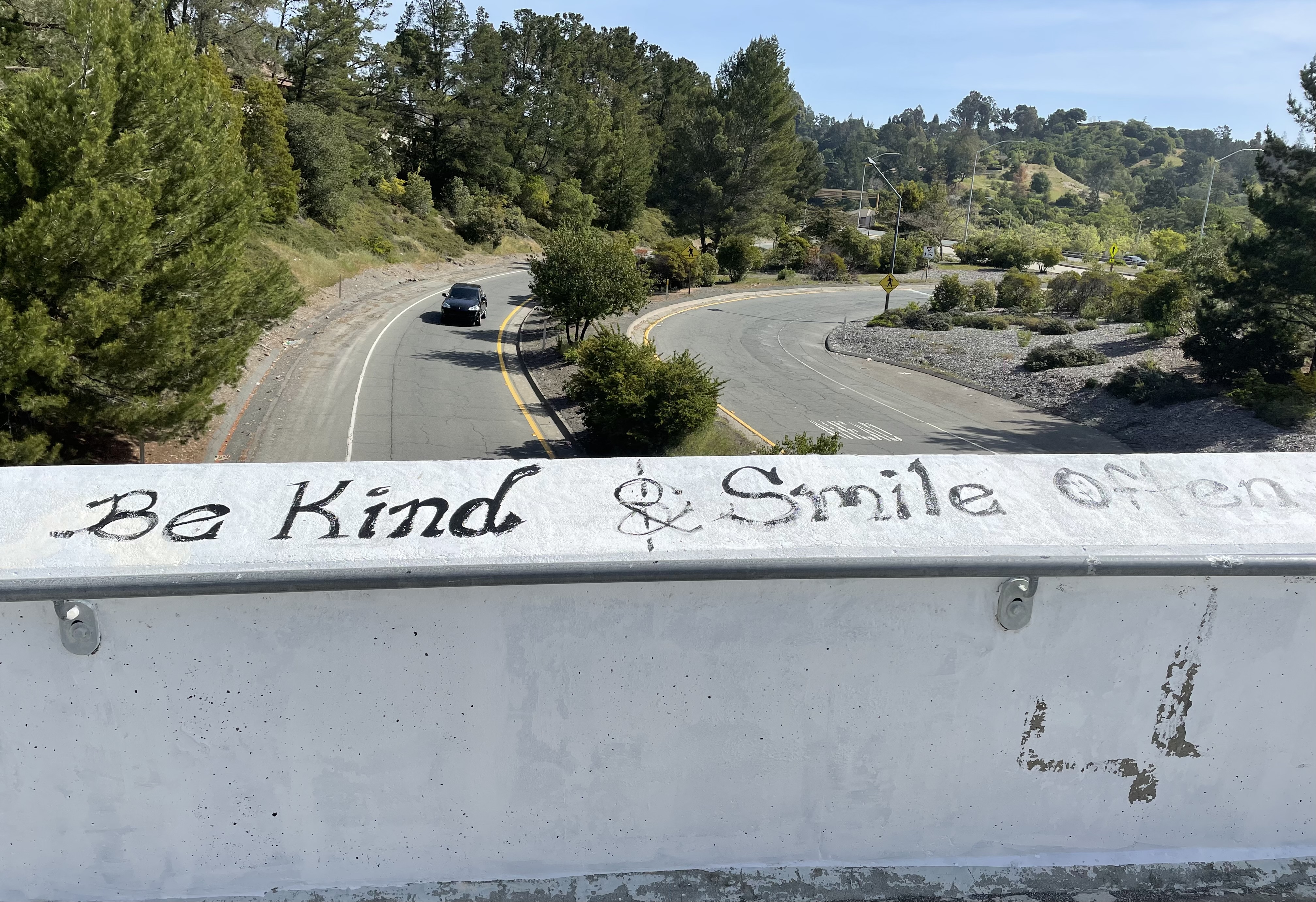
Bridge over the freeway on/off ramps. The message made me smile.
Something’s happening to the side of the library. Can you make out the head of an otter? I wonder what’s he’s up to! Perhaps he’s going into outer space … the first otter astronaut from Borinda!
I am slowing down, there’s no doubt. Clearing out closets, taking longer and longer walks. Rewriting and rewriting the same story as though shaving off bits of my life. I just put away the Christmas ornaments that have been hanging from potted plants for over two years. Each one was given to me by someone special … many gone … some just recently, others long ago. But wait. Didn’t Auntie Dottie just pass? I can still hear her laugh. Eventually it doesn’t seem to matter … the years between.
My troll family from Finland.
But there is tomorrow and perhaps the mural on the library wall will start to make sense. Certainly more sense than war and genocide and why anyone would pay over a million dollars to bulldoze a house.
Once Upon a Time in Hollywood is a “what if” movie written and directed by Quentin Tarantino. Matt Damon plays Rick Dalton, a washed up cowboy star at a time when Roman Polanski is the hottest director in town (the late 1960s). Polanski is renting the house next door to Dalton but he and his friends live in the fame bubble, everything is wonderful and will be forever and ever. There’s even a scene of Sharon Tate going into a theater alone just to revel in the audience reaction to her movie while Dalton drowns in self pity, aided by his longtime stunt double, Cliff Booth (Brad Pitt).
This movie could have had a predictable ending but it doesn’t. I won’t give away Tarantino’s secret sauce in case you haven’t seen it, but damn if Fractured Fairytales didn’t immediately leap to mind.
If you don’t have time to watch the clip, the story starts out familiar and then veers wildly astray, generally into areas of extreme political incorrectness! I’m sure if Fractured Fairytales were on air today, there would be howls from all sides. But, if I ever met Tarantino, I’d have to ask him what role the old Rocky and Bullwinkle cartoons had in his vision for movie making. I think he’s old enough to have watched them. Maybe not. Sigh.
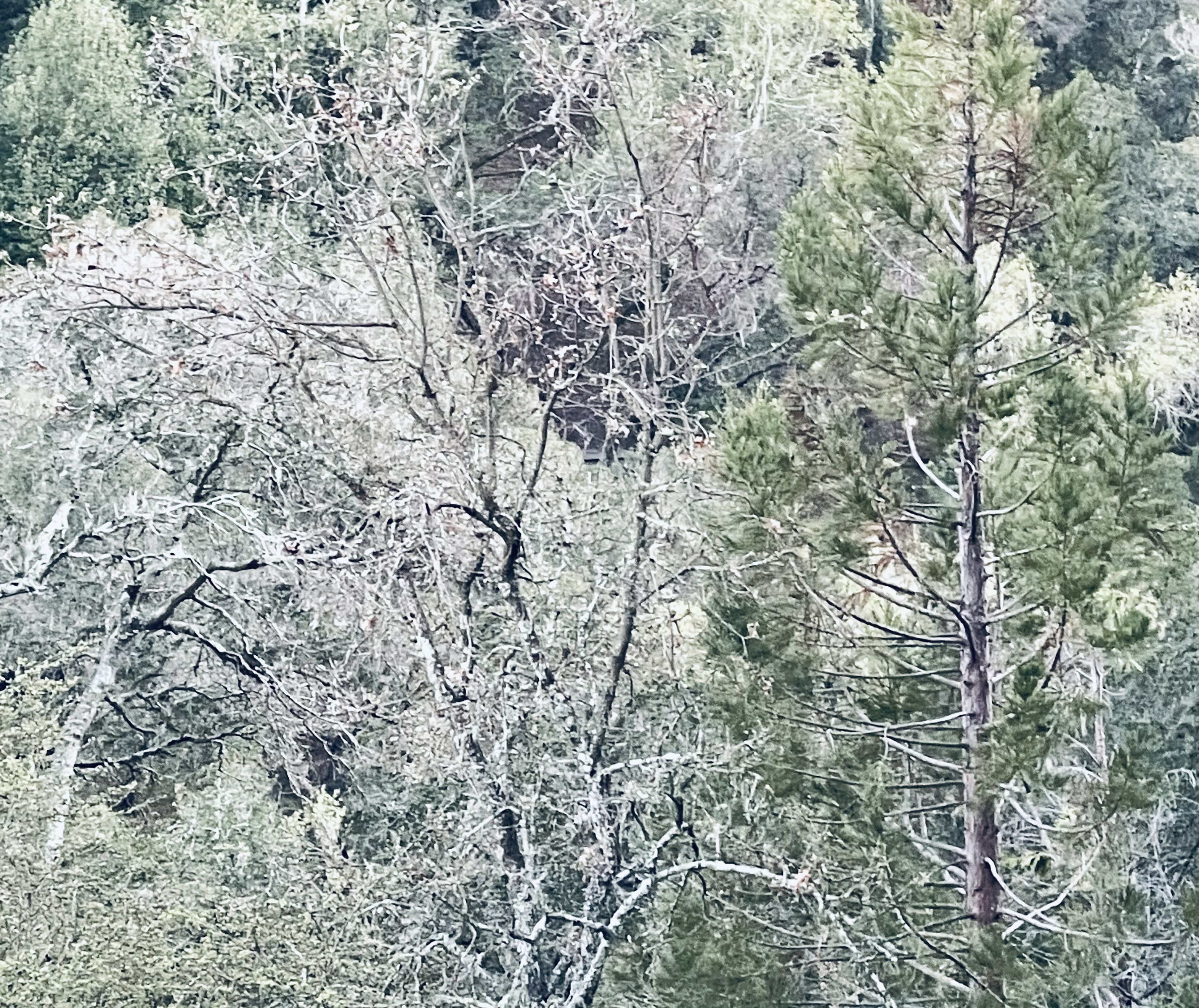
I took this shot from my deck yesterday. Have you ever taken a picture that captures exactly the way you feel? The oak in the middle of the picture is not dead. It wasn’t even covered in ice. It was as if the trees felt my despair and spoke to me. We feel it too. The world feels it.
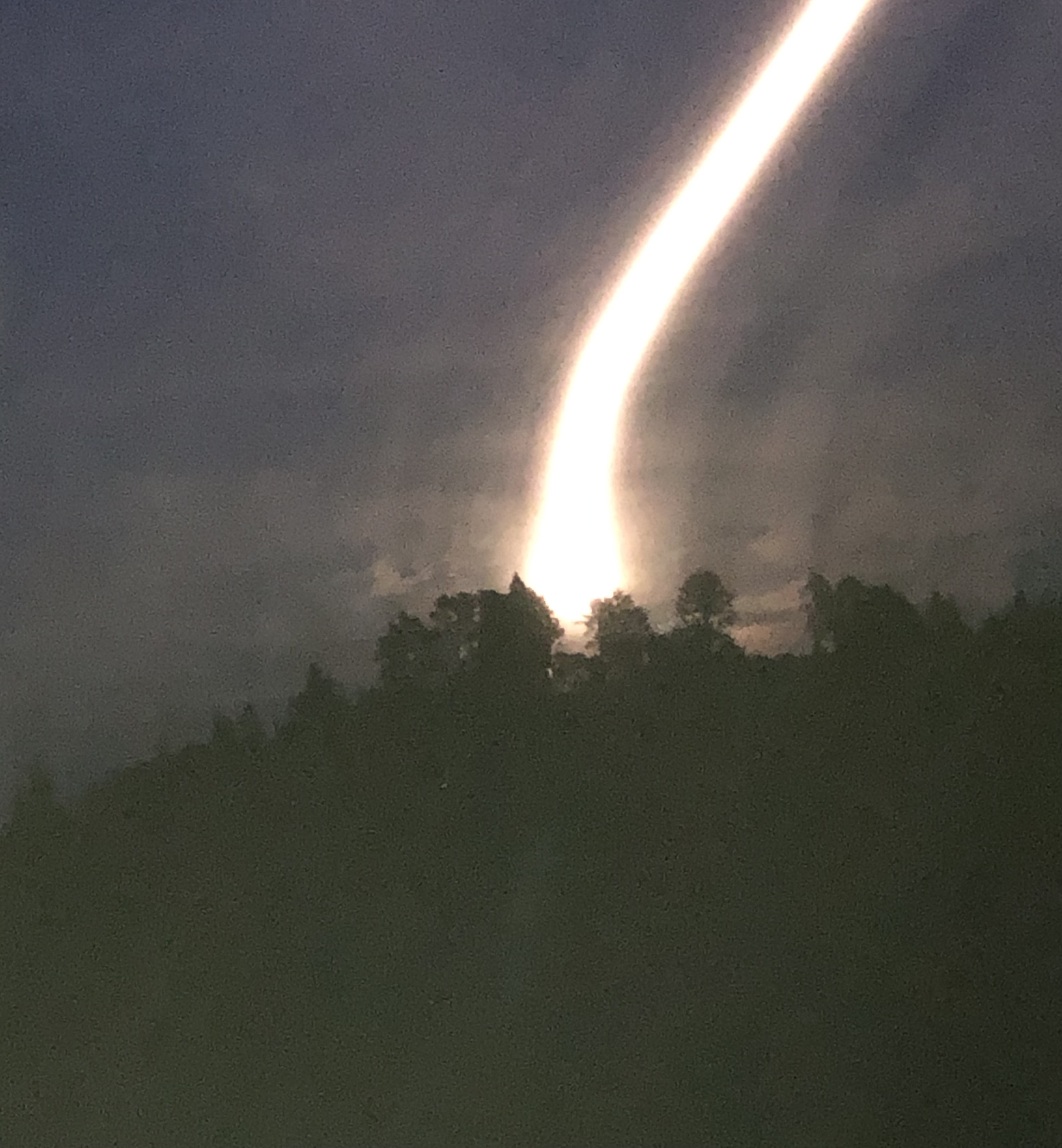
A few years back I took this picture:
I have no idea what buttons I pushed on the iPhone to get the shot. I was feeling apocalyptic at the time but the moon didn’t blow up.
So many bloggers I’ve known for years are quitting. It started during the Trump years when it was hard to sit down at the keyboard and pretend half the US hadn’t just lost their minds. And then came the plague which brought forth a fresh round of craziness. For many bloggers, it was saner to just walk away.
And now we have this unthinkable war and what can you say? Nothing because it’s already been said again and again and again.
The last sun of the century set amidst the blood red clouds of the West and the whirlwind of hatred the naked passion of selflove of Nations, in its drunken delirium of greed, is dancing to the clash of steel and the howling verses of vengeance The hungry self of Nation shall burst in a violence of fury from its own shameless feeding For it has made the world its food
R. Tagore, written just before WWI
“For every storm, a rainbow; for every tear, a smile.” An old Irish blessing
The other day I was feeling nostalgic and old, which in my case, sometimes manifests a poem (or my attempt at a poem). To Carol and Griselda
I always feared the eucalyptus grove.
But to get to castle rock,
And brag to hesitant bones that our minds
still had the power to rule our wretched bodies.
And that time
Mighty time, unforgiving time,
had no harness we couldn’t break …
We had to pass through the eucalyptus grove.

Our walk till then, under open skies,
With horizons both east and west
As far as the mind could fathom
Of the ocean and the mountains,
The cows grazing in the fields
And ships heading out to sea,
The city below with all of it’s nooks and crannies exposed
Deceived us into lazy thinking.

And then, to toad-croak mating songs, we’d enter the grove
Pelted by pods and petal-less flowers
Twigs and eucalyptus dust from
the murmuring and jiggering …
Constant flapping of earth bound wings
Trapped and endlessly wailing …
Even on a calm day … Gum trees.

Oh the smell!
you would say and lapse into thinking
You could win
One more madcap challenge to the Outback,
Just one more time with old Matilda
Riding Black
Just one more time,
A skinny dip in the Indian Ocean after
Days of sweat and dust.

The boughs are cracking over head and we are drifting, I know not where …

Then let’s run! Run through the eucalyptus grove.

Something was always lost or stolen
each time through that grove.
Could you feel it?

No, I couldn’t either.
Not at the time.

Then let’s run as fast as we can,
through the eucalyptus grove.
I’m not really gloating because we are still in a drought out here in Northern California and no one in their right mind wants to be in a drought … but January has been beautiful and February is starting out the same. There’s been a lot of moisture from fog and overnight frost but no real rain. So panic is setting in.
Looking west as the sun rose this morning.
Pickle ball mania has taken over my section of the world. It’s basically tennis for people who no longer want to run all over the court chasing balls. Basically, older people. So yesterday I decided to try it along with a couple of friends I’ve had for decades. They’d been in touch with a woman from our old adult soccer team who said she’d teach us. I hadn’t seen the lady in thirty years and thus, did not recognize her. Our conversation went like this:
Me: Are you the one who backed up into a pole and smashed her Mercedes?
Deb: No!!! I’ve never owned a Mercedes! I’m an engineer! Are you the lady who lost her baby at one of our soccer matches?
Liz: That was me. I lost Daniel.
Me: Oh yeah. That was the CFO who smashed her Mercedes.
Pat: That was Susan. She came with that guy who was always getting injured.
Me: The tax attorney. He told me he didn’t feel like he’d gotten enough exercise unless he got injured!
Deb: Speaking of taxes, did they ever throw your ex-husband into prison?
Me: No, somehow he got out of it. But he got into some other shenanigans.
Pat: I bet. Didn’t we find the baby sleeping under a blanket?
Eventually we did get to playing the game … in a way. A pickle ball game is considered successful if you can sustain a volley instead of land “winners.” So it’s fun. Relaxed and not at all serious. Especially if you’re remembering fun times from long ago when you were all young.
We decided to make the Whatcha Gonna Do Stew exactly as written by Chris LeDoux, singer and songwriter. In case you don’t remember, it consisted of two steps: 1.) Chop vegetables and meat. 2.) Dump into pot of boiling water and cook until “good enough to eat.”
I cheated and added a bag of Herbs of Provence. It didn’t help. It tastes every bit as yummy as it looks.
First, you do not want to use too much water otherwise you don’t have stew; you have soup. Second, meat cooked in boiling water tastes like rubber. Even a good cut of meat. Luckily I don’t like meat so I didn’t use very much.
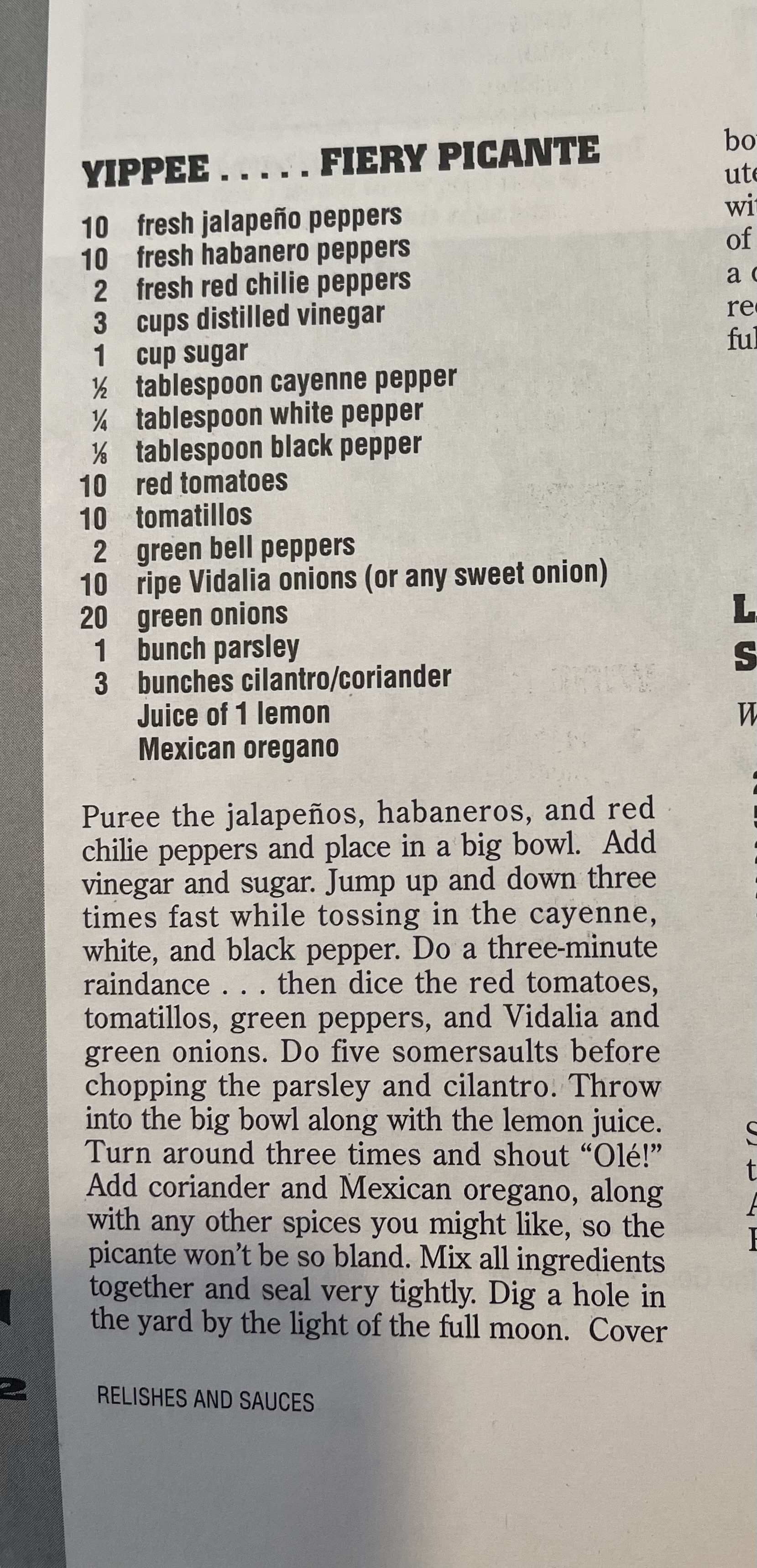
I should have made this picante sauce to go along with my stew – 10 jalapenos! That would have added some flavor!
One bit of caution: if you do decide to try this recipe, don’t use minced garlic from a jar. It just floats on the top of the water and looks very unappetizing.
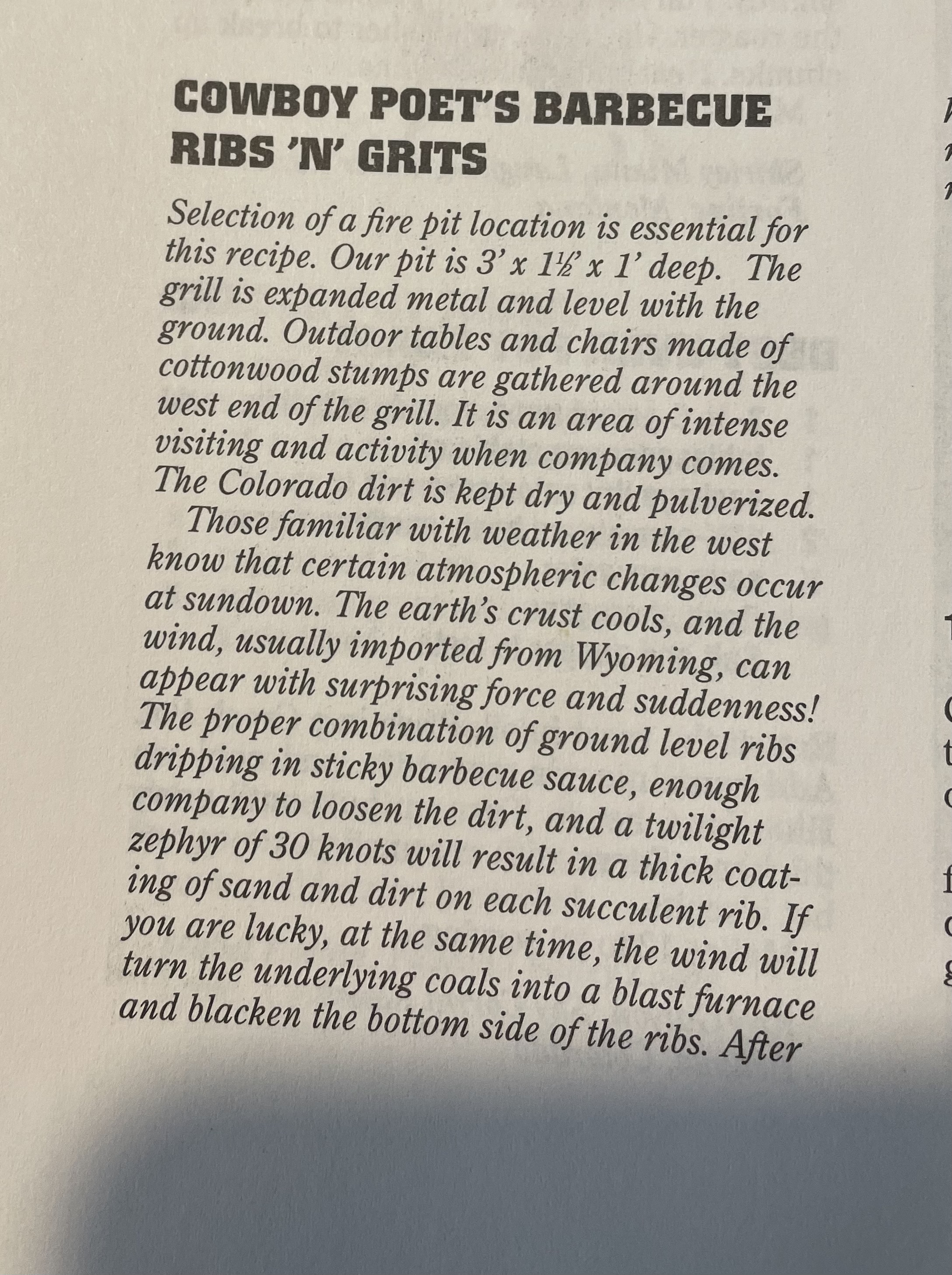
According to the Cowboy Poet, I probably should have made my stew in a hole in the ground (in Texas with Colorado dirt and the Wyoming wind, of course).
I didn’t know anything about Chris LeDoux, who died way too young, but apparently “whatcha gonna do” was his tagline. If you go to his website, you can purchase all kinds of goodies including his “Whatcha Gonna Do” wines and spirits. Below is one of his songs.
If he had lived longer, perhaps he would have starred in his own Whatcha Gonna Do Cooking show. Unlike other cookin’ shows, no need for trips to the store for fancy spices. Just meat, potatoes and vegetables all cooked in some water. I have a feeling he was a cool guy to know but Jacques Pepin, he was not! But … whatcha gonna do?